Why Artificial Intelligence is Changing Search Engine Optimization

Artificial intelligence seo is revolutionizing how websites get found, ranked, and featured in search results. This guide covers the essentials:
Key Components of AI in SEO:
- Machine Learning algorithms that understand user intent beyond keywords.
- Natural Language Processing (NLP) for semantic search and content analysis.
- Predictive analytics for forecasting trends and algorithm changes.
- Automated optimization of technical SEO elements at scale.
- Content generation and improvement tools powered by large language models.
The search landscape has fundamentally shifted. With Google processing 5.9 million searches every minute and 58% of SEO professionals integrating generative AI this year, traditional keyword strategies are no longer sufficient. Success now requires adapting to how search engines think.
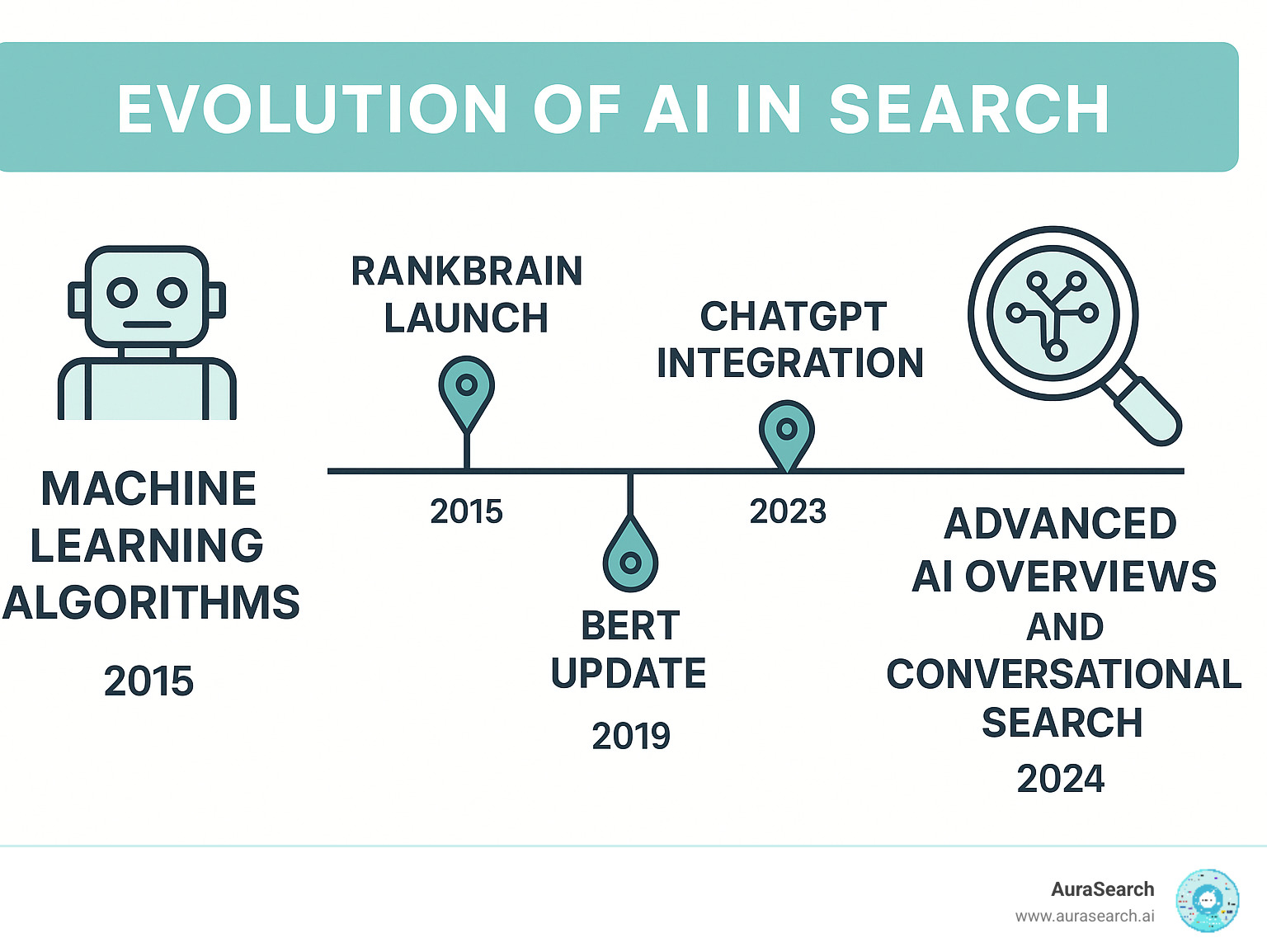
AI systems like Google's RankBrain, BERT, and MUM, along with new experiences like ChatGPT and AI Overviews, are rewriting the rules. For marketers, this means moving beyond old tactics and understanding how AI evaluates content quality, user satisfaction, and topical authority to achieve visibility.
The Foundations: What is AI in SEO and How Does It Work?

Artificial intelligence seo involves using AI technologies to improve website optimization. Instead of relying on manual work and static rules, we leverage machine learning (ML) and natural language processing (NLP) to make smarter, more efficient decisions.
At its core, Machine Learning (ML) allows systems to learn from vast amounts of data and improve over time without explicit programming. For SEO, this is crucial for adapting to Google's thousands of annual algorithm tweaks. Natural Language Processing (NLP) enables AI to understand and generate human-like text. This allows search engines to grasp the meaning and context behind queries, not just keywords. Google's RankBrain and BERT are prime examples of NLP in action, delivering more relevant results.
This table highlights the shift from traditional methods to AI-driven strategies:
| Feature | Traditional SEO | AI-Driven SEO |
|---|---|---|
| Focus | Keywords, backlinks, on-page elements | User intent, context, semantic relevance, content authority |
| Keyword Research | Manual analysis, keyword density, volume | Semantic clustering, predictive forecasting, intent classification |
| Content Creation | Manual writing, keyword stuffing risk | AI-assisted generation, optimization for E-E-A-T, human oversight |
| Analysis | Retrospective, manual data review | Real-time, predictive analytics, anomaly detection, big data processing |
| Adaptability | Slower to react to algorithm changes | Rapid adaptation, proactive adjustments based on AI insights |
| Scalability | Limited by human capacity | High, automates repetitive tasks across vast datasets |
The Evolution from Keywords to Context
The era of keyword stuffing is over. AI has driven the shift from keywords to understanding user intent. Google's updates like RankBrain (2015), BERT (2019), and the powerful MUM (2021) have transformed how search engines interpret queries. They no longer just match words; they analyze context and relationships between concepts (semantic search) to determine the user's true goal. This allows for a deeper understanding of search behavior and more effective content creation.
How AI is Changing the SERP
AI is also reshaping the search engine results page (SERP) itself. Features like Google's AI Overviews provide direct, synthesized answers, often eliminating the need to click through to a website. As of March 2025, these overviews appeared in 13.14% of searches, contributing to the rise of "zero-click searches." A 2024 study found that 58.5% of U.S. Google searches ended without a click. This highlights the need to optimize content to be featured within these AI-generated results. Clear, concise content that directly answers questions is cited 31% more often. AI also improves traditional features like featured snippets, creating a more personalized and efficient user experience.
Strategic Implementation: How to Leverage Artificial Intelligence SEO

Leveraging artificial intelligence seo means weaving AI into your strategy, content, and analysis. Think of AI as an efficient assistant that handles data-heavy tasks, freeing up your team for high-level strategic work. With 17% of marketers saving over 10 hours weekly using AI for SEO, the productivity gains are significant.
Supercharging Keyword Research and Competitor Analysis
AI lifts keyword research from simple word-finding to understanding the entire search landscape. Tools now offer:
- Topic Clustering and Intent Classification: AI groups keywords by user intent, helping you build comprehensive content that covers a topic from all angles.
- Predictive Forecasting: AI can spot emerging search trends weeks before they become mainstream, giving you a head start on content planning.
- Content Gap and Competitor Analysis: AI analyzes competitor content at scale, identifying their successful strategies and revealing overlooked opportunities for you to capture.
For more details on how we can boost your strategy with these advanced techniques, don't hesitate to explore our AI SEO services.
Revolutionizing SEO-Optimized Content Creation
AI is a powerful content creation assistant, not a replacement for human expertise. Use it to amplify your efforts:
- Content Briefs and Outlines: AI can generate title tags, FAQs, and outlines to structure your content for readers and search engines.
- Writing Assistance: AI can provide initial drafts, paraphrase text, and improve clarity, which is useful for creating summaries or social media snippets.
- E-E-A-T Optimization: AI helps incorporate signals for Experience, Expertise, Authoritativeness, and Trustworthiness (E-E-A-T) by suggesting elements like author bios and data-backed claims. Content with strong entity schema is 51% more likely to appear in knowledge panels and AI answers.
Best Practices for AI Writing: Always review and edit AI-generated content for accuracy, tone, and originality. Your goal is helpful, human-centric content. Google's stance is clear: helpful AI content is fine, but using it primarily to manipulate search rankings violates their spam policies, a focus of the March 2024 Core Update.
Enhancing Technical SEO and Performance Tracking
AI makes the foundational work of technical SEO more efficient and insightful.
- Advanced Data Analysis: AI processes massive datasets to uncover subtle issues in site structure or crawl behavior that humans would miss. 62% of marketers now use generative AI for data analysis.
- Predictive Analytics & Anomaly Detection: AI acts as an early warning system, anticipating algorithm shifts and instantly spotting performance anomalies like a drop in crawl rate.
- Automated Checks & Monitoring: Tools can automate indexing checks and provide real-time monitoring of keyword positions and traffic, ensuring your SEO program remains agile and data-driven.
The Future of Search: SEO's Evolution in the Age of AI

The future of search is already here, driving a fundamental shift in how we find information. This has given rise to new concepts like Generative Engine Optimization (GEO) and forces us to rethink artificial intelligence seo . Instead of just typing queries, users are having conversations with AI systems that provide synthesized answers, creating new challenges and opportunities for optimization.
Will SEO Continue to Exist? The Dynamic Between Human and Machine
Will SEO survive the AI revolution? Absolutely, but it will look very different. As long as people need to find information online, there will be a need to optimize that process. AI isn't replacing SEO professionals; it's augmenting them.
Think of AI as a powerful research assistant that handles data analysis and pattern recognition. This frees up human experts to focus on what they do best: strategy, creative problem-solving, and understanding user motivations. The role of the SEO professional is shifting from manual execution to strategic orchestration—guiding AI, interpreting its output, and aligning insights with business goals. The future of SEO is evolving, not ending.
Key AI SEO Trends and Innovations for 2025
Looking ahead, several key trends are reshaping the artificial intelligence seo landscape:
- Hyper-personalization: AI is delivering search results custom to individual user history, preferences, and context. Content must be relevant to the specific person, not just a broad topic.
- Voice and Visual Search Optimization: With the rise of smart speakers and image recognition, content must be optimized for natural, conversational language and include descriptive metadata for images.
- Predictive SEO: AI tools are moving from reactive analysis to proactive optimization, helping us anticipate algorithm changes and market shifts weeks in advance.
- Proactive Algorithm Adaptation: Advanced AI systems can detect algorithmic shifts within hours, suggesting immediate adjustments to maintain optimization.
Despite these changes, the outlook is positive. Statista reports that 49.1% of professionals believe AI will have a positive impact on traffic over the next five years, thanks to the efficiency and precision it brings to SEO.
Practical Applications and Ethical Considerations
Let's get practical: how can you use artificial intelligence seo responsibly in your business? AI tools are scalable for any size company, from a local shop to a growing startup, but using them correctly is key.
Applying Artificial Intelligence SEO in Your Business
AI can level the playing field for businesses of all sizes.
- For Local SEO: AI helps small businesses compete with larger chains by analyzing local search patterns to capture high-intent "near me" searches. It can also automate the management of online listings and monitor customer reviews.
- To Attract Investment: Strategic SEO can help businesses attract investors. By using AI to identify what potential investors are researching, you can create targeted content that positions your company as the ideal solution.
Staying competitive means embracing AI. Your competitors are already using these tools, so the question isn't if you should adopt AI, but how quickly you can do so responsibly.
Navigating the Ethics and Avoiding AI Pitfalls
With great power comes great responsibility. While AI makes content creation easy, quality is paramount.
- Data Privacy and Misinformation: Be aware of the data your AI tools collect. Always have a human expert verify AI-generated information for accuracy to prevent the spread of misinformation.
- Google's Policies: Google's Helpful Content system is designed to combat low-quality, manipulative content. The goal is to help users, not just game the algorithm. Google's spam policies are clear: content created primarily to manipulate rankings is considered spam, regardless of how it's made.
- Human Oversight is Essential: The key to ethical AI use is human oversight. AI should amplify your expertise, not replace it. Every piece of AI-assisted content needs a human to review it for accuracy, add unique insights, and ensure it serves the audience. This approach to content quality control builds trust and delivers real SEO results.
Frequently Asked Questions about AI in SEO
It's natural to have questions about a technology as transformative as artificial intelligence seo . Here are answers to some of the most common inquiries.
Is AI-generated content bad for SEO?
No, AI-generated content is not inherently bad for SEO. Google's priority is high-quality, helpful content, regardless of its origin. If content created with AI assistance is useful, original, and demonstrates E-E-A-T (Experience, Expertise, Authoritativeness, and Trustworthiness), it can rank well. The key is quality over origin . Low-quality, spammy content will perform poorly, whether written by a human or an AI.
Can AI replace SEO professionals entirely?
No, AI will not replace SEO professionals. It's best viewed as a powerful co-pilot that handles repetitive, data-intensive tasks. AI lacks the creativity, critical thinking, and strategic nuance that humans provide. The role of the SEO professional is evolving to become more strategic: guiding AI, interpreting its insights, and focusing on the human elements of marketing and user behavior. We are becoming the conductors of an AI-powered orchestra, not members of the audience.
What are the best types of AI-powered SEO tools?
The AI SEO tool landscape is expanding rapidly. Key categories include:
- Content Optimization Platforms: These tools use AI to research and refine content, ensuring it has semantic relevance and topical authority.
- Technical SEO Crawlers: AI-improved crawlers dig deep into a site's architecture to find and predict technical issues that could impact rankings.
- Keyword Research Tools: Modern tools use NLP to cluster keywords by user intent, forecast trends, and uncover conversational queries.
- Generative Engine Optimization (GEO) Trackers: These new tools are designed to track and optimize for visibility within AI-powered search features like Google's AI Overviews.
For a deeper dive into specific tools and how they can boost your SEO efforts, we encourage you to explore our AI SEO blog for tool insights.
Conclusion: Embracing the Future of Search
We've journeyed through artificial intelligence seo , and the key takeaway is clear: this is a permanent evolution, not a passing trend. AI is a strategic partner that will redefine how we approach search optimization.
AI handles the heavy lifting—data analysis, pattern recognition, and automation—freeing up SEO professionals to focus on strategy, creativity, and understanding user needs. The rise of AI Overviews and the focus on E-E-A-T signals prove that the future of SEO is about creating genuinely helpful content .
Adaptation is crucial. The businesses that thrive will be those that accept AI as a powerful ally. While the tools have changed, the core mission of connecting people with the information they need remains the same.
At AuraSearch , our mission is to help businesses steer this transition. We are specialists in generative AI SEO services , uniquely focused on optimizing for both traditional search and emerging AI platforms like ChatGPT and Google AI Overviews.
The future of search is intelligent, but it's also fundamentally human. AI amplifies our capabilities, but it doesn't replace the creativity and strategic thinking that drive impactful results.
Ready to accept this AI-powered future? Get started with AI-driven SEO today and join the businesses already winning in tomorrow's search landscape.