Why AI Competitor Analysis is Your Secret Weapon

AI competitor analysis uses artificial intelligence to automatically track, analyze, and interpret your competitors' strategies. Instead of manual research, AI tools scan thousands of data points in minutes, surfacing actionable insights you might have missed.
Here's what AI competitor analysis covers:
- SEO & Content : Track competitor keywords, backlinks, and content performance
- Social Media : Monitor engagement, sentiment, and campaign strategies
- Pricing & Products : Compare features, pricing changes, and market positioning
- Technology : Identify competitor tech stacks and innovation patterns
- Market Intelligence : Spot emerging trends and new market entrants
The numbers tell the story: one hour of competitive analysis can save you days or weeks of product development. Companies using AI-powered tools often save 30 to 60 work hours per month compared to manual research methods.
The real kicker is the shift from reactive to proactive analysis. Instead of seeing what competitors did last month, AI can predict future moves and provide real-time alerts.
This shift matters more than ever. As search evolves with AI platforms like ChatGPT and Google's AI Overviews, understanding how competitors adapt gives you the edge to stay visible when traditional SEO tactics fall short.
The challenge isn't whether to use AI for competitor analysis—it's choosing the right approach and avoiding common pitfalls.

From Manual Grind to Automated Insight: The Core Benefits of AI
Manually researching competitors is a tedious chore: clicking through websites, copying data to spreadsheets, and trying to make sense of it all. The problem isn't just boredom; it's inefficiency. AI competitor analysis accomplishes in minutes what used to take days, shifting the focus from data hunting to strategic insight.
AI-powered analysis uses intelligent algorithms to scan and process thousands of data points simultaneously—a scale impossible for human teams. As one industry expert puts it, one hour of competitive analysis can save you days or weeks of product development and iteration .
Beyond speed, AI offers precision and predictive capabilities . It turns raw data into a strategic advantage by spotting patterns to predict what competitors might do next, rather than just showing what they did last month.
Opening Up Unprecedented Efficiency
Manual competitor research is a time sink. Visiting multiple competitor sites and social profiles can consume a day just to collect surface-level information.
AI automation changes this completely. These tools can simultaneously gather data from competitor websites, social media platforms, review sites, and news sources. They work 24/7, never get tired, and don't miss important updates while you're focused on other tasks.
The numbers speak for themselves: businesses using AI tools typically save 30 to 60 work hours per month . That's a full work week you can redirect toward strategy and innovation.
This improves resource allocation . Your team can focus on interpreting insights and making strategic decisions, shifting from data collection to action.

Gaining Deeper, More Actionable Insights
Manual research is surface-level. You might see a new product launch but miss the strategic patterns behind it.
AI algorithms find hidden trends in massive datasets. Using Natural Language Processing (NLP) , they analyze thousands of customer reviews, social media comments, and forum posts to understand sentiment and pain points.
This depth transforms decision-making. You can spot opportunities competitors are missing, like a feature gap customers consistently complain about, and fill that need first.
The US Chamber of Commerce outlines key areas where AI can help your research , including real-time monitoring and predictive trend analysis. This means you're not just collecting data—you're uncovering actionable intelligence that directly informs your business strategy.
The shift from reactive to proactive decision-making is perhaps the most valuable benefit. When you understand not just what competitors are doing, but where they might go next, you can stay several steps ahead.
Key Areas AI Transforms in Competitor Analysis
The magic of AI competitor analysis isn't just that it's faster—it's how comprehensive it can be. Instead of analyzing just one piece of the puzzle, like SEO or social media, AI gives you the full picture at once.
Think of it like having a command center that monitors every move your competitors make across the digital landscape. This holistic approach means you're not missing crucial insights.
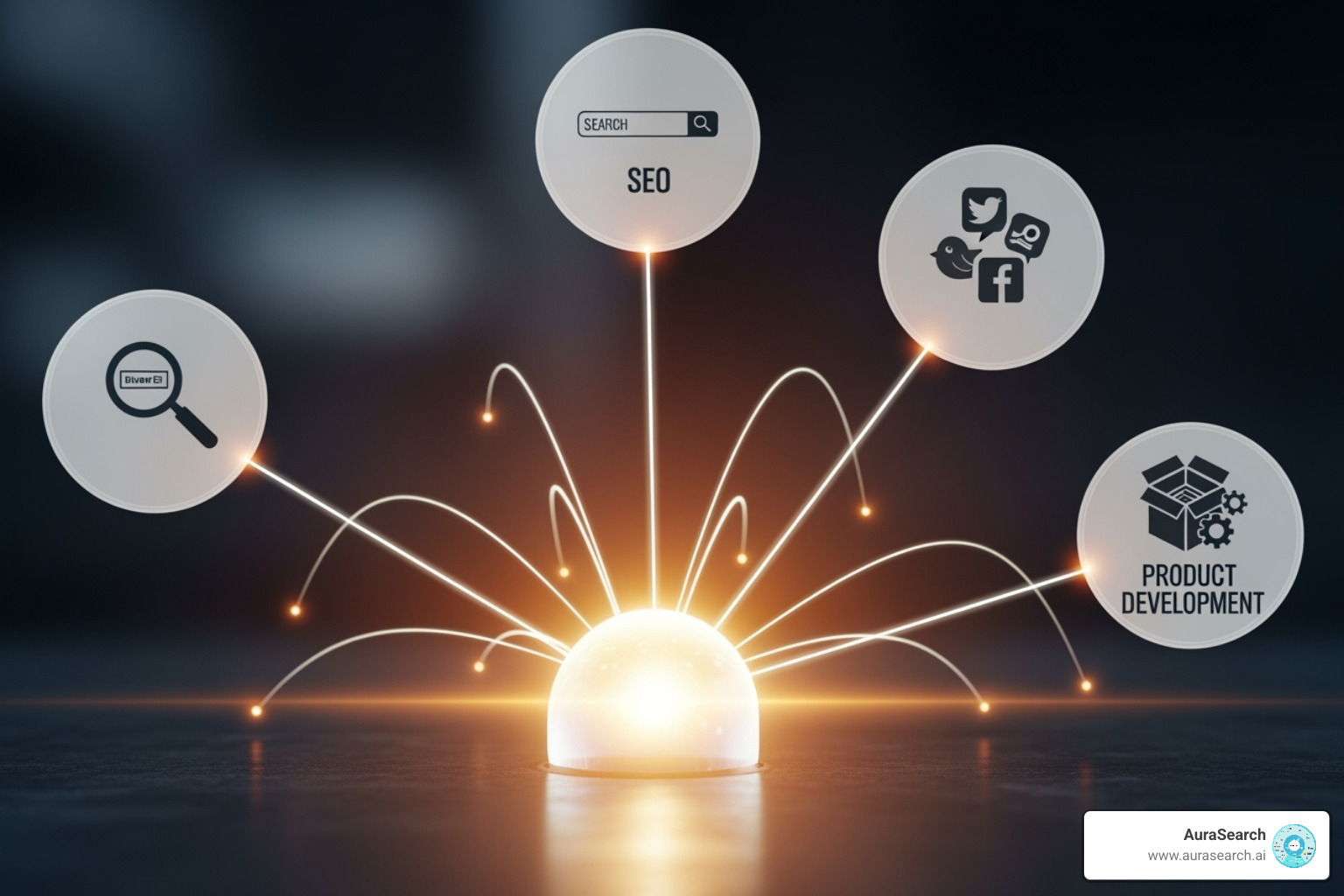
SEO and Content Strategy: An AI Competitor Analysis Deep Dive
Understanding competitor SEO is crucial for online visibility. AI removes the guesswork, showing you exactly what works for them.
Keyword gap analysis is where AI really shines. It can spot keywords your competitors rank for that you're completely missing. These are often high-value opportunities that can drive significant traffic.
Backlink profile comparison reveals who's linking to your competitors. This helps find link opportunities they missed, not just copy their strategy. AI can also track content performance metrics to show you which competitor articles get the most engagement.
The real game-changer is topic clusters and SERP analysis . AI maps out competitor content authority, showing where they dominate and where gaps exist. This helps businesses optimize their online strategies with data-driven insights.
As search evolves with AI platforms, understanding these patterns becomes even more critical. For businesses looking to stay ahead of these changes, more info about AI SEO services can help steer this shifting landscape.
Social Media and Sentiment Analysis
AI transforms social media analysis from guesswork into a precise science, tracking metrics like share of voice and customer sentiment in real-time.
Engagement analysis goes beyond counting likes. AI can identify which types of posts generate meaningful conversations and which hashtags move the needle.
Influencer campaign monitoring helps you spot when competitors partner with key voices in your industry, revealing their collaboration strategies.
The most interesting part is identifying competitor weaknesses from public feedback . AI catches sentiment shifts from customer complaints or praise, allowing you to learn from their mistakes and successes instantly.
Product and Pricing Benchmarking
AI provides detailed, automatically updated product comparisons, replacing the need for expensive market research firms.
Feature-by-feature comparison tools analyze product pages and reviews to create comprehensive competitive matrices, showing exactly where you have an edge.
Pricing model analysis tracks more than just sticker prices. AI monitors promotions, subscription tiers, and bundling offers to help you position your pricing competitively.
The real value is in identifying market gaps . AI spots patterns in customer complaints or feature requests, revealing opportunities for differentiation.
Product benchmarking becomes a continuous process, helping you refine your value proposition based on real market data.
Technology and Innovation Scouting
AI-powered innovation scouting acts as a crystal ball, helping you look beyond today's actions to what competitors might do tomorrow.
Competitor tech stack analysis reveals the tools your rivals use. This helps you understand their capabilities and limitations. For example, a new customer service software adoption might signal a plan to scale support.
Tracking new market entrants helps you spot threats before they become serious problems. AI can monitor startup funding, new product launches, and emerging companies.
Monitoring patent filings and emerging technologies takes this even further. AI scans patent databases to identify breakthrough technologies your competitors might be developing. This forward-looking approach to innovation scouting to mitigate risk gives you time to adapt your strategy before market shifts happen.
A Practical Framework for Your First AI Competitor Analysis
Ready to dive into AI competitor analysis ? The technology might sound intimidating, but modern AI tools are designed for business users, not data scientists.
Think of this as your roadmap to competitive intelligence. We'll walk through a simple three-step process to take you from uncertainty to a clear plan for outperforming your competition.
Step 1: Define Goals and Identify Competitors
Before using any AI tool, get clear on your goals. This crucial step separates useful insights from irrelevant data.
Start with your burning questions. Are you wondering why competitors rank higher in Google? Curious about their pricing? Want to understand their social media approach? Write down your top questions to guide your analysis.
Set measurable goals that tie back to your business, like increasing organic traffic by 25% or identifying five new keyword opportunities.
Now, identifying your competition . Start with direct competitors, but also include indirect ones—businesses solving the same customer problem in different ways.
AI can also find competitors you didn't know existed . Describe your product, service, and keywords, and let the AI scan the web to identify others competing for your customers.
Step 2: Execute the Analysis and Synthesize Insights
This is where the magic happens. Modern AI tools are straightforward, doing the heavy lifting behind the scenes.
Running the analysis usually involves plugging in your business details and selecting competitors. The AI then gathers information from websites, social media, and review sites, often completing a comprehensive analysis in minutes.
The best part is getting visual insights like charts and graphs, not just spreadsheets. These visuals make it easy to see where you're winning and where you're falling behind.
Many advanced tools will even generate a SWOT analysis automatically, giving you a solid foundation for your strategy.
Pattern recognition is where AI excels, spotting trends and connections that would take humans weeks to uncover. Perhaps your competitors all struggle with customer service or are missing opportunities in mobile optimization.
Finally, synthesis . Generative AI can summarize the raw data into clear, actionable reports, giving you the key insights that matter.
Step 3: Integrate Insights into Your Business Strategy
Insights are useless if they sit in a report. The goal is to integrate this competitive intelligence into your business strategy.
- Your product roadmap should reflect what you've learned. If competitors are missing key features, that's your opportunity.
- Marketing becomes more targeted when you understand the competitive landscape. Craft messages that highlight your strengths and address competitor weaknesses.
- Sales teams love this stuff. Give them clear battlecards showing competitor strengths and weaknesses so they can have more confident conversations.
- Pricing decisions become data-driven. Real-time monitoring of competitor pricing lets you stay competitive without leaving money on the table.
The key is to make this an ongoing process . The competitive landscape shifts constantly, so set up regular monitoring, especially during new launches or market entries.
This isn't about copying others—it's about understanding the playing field to make smarter moves. For more insights on turning competitive intelligence into winning strategies, check out the AuraSearch AI Blog.
Navigating the Pitfalls: Best Practices and Limitations
While AI competitor analysis is a powerful ally, it's not a silver bullet. Understanding its limitations is just as important as using its strengths. We need to approach AI with a critical eye to get accurate, actionable insights without falling into common traps.
Best Practices for Accurate AI Competitor Analysis
To leverage AI tools effectively, follow these best practices:
- Human Oversight and Verification : AI is an assistant, not a replacement for human intellect. View AI insights as a starting point to be verified and refined by professionals.
- Combining Quantitative and Qualitative Data : AI excels at quantitative analysis but can miss qualitative nuances. Supplement AI findings with research like customer interviews or expert opinions.
- Ensuring Data Privacy : When using AI tools, comply with all data privacy policies. Never share privileged or nonpublic information.
- Using Multiple Data Sources : Relying on a single AI tool can lead to a biased view. Cross-reference insights from different tools to build a more comprehensive picture.
- Regular Model Calibration : The market is dynamic. Regular calibration ensures that the AI continues to provide relevant insights as the competitive landscape evolves.
Understanding the Limitations of AI
Despite their capabilities, AI tools have limitations:
- 'Black Box' Problem : It can be difficult to understand how an AI reaches a conclusion. This "black box" nature can make it hard to trust insights without further investigation.
- Potential for Data Bias : AI models learn from their training data. If the data is biased, the AI's analysis will be too, leading to inaccurate insights.
- Lack of Nuanced Context : AI struggles with human nuances like sarcasm, cultural context, or the motivations behind competitor actions.
- Hallucinations in Generative AI : Generative AI can "hallucinate" or create factually incorrect information. Always verify its output before making decisions.
- The Importance of Human Expertise : As Bryan Dohmen from Hero Digital highlights, AI helps us get a broader view faster, but the deeper refinement and strategic application still require seasoned professionals. AI provides a starting point; human expertise provides the critical thinking and strategic interpretation.
Recent analysis shows AI-based systems can help uncover competitor pain points and predict product strategies. This capability is phenomenal, but it underscores that AI is a tool to augment, not replace, human analysis. It excels at processing patterns, but strategic decisions still rest with us.
Frequently Asked Questions about AI Competitor Analysis
We get it—diving into AI competitor analysis can feel overwhelming. Let's tackle the most common questions.
Can I use AI for competitor analysis in any industry?
Yes, absolutely. AI competitor analysis tools are highly adaptable. They work for any industry, from local bakeries to tech startups, as long as your competitors have a digital presence.
The AI analyzes digital patterns and strategies, which are common across all industries. If your competitors are online, AI can help you understand their activities.
What if I don't know who my competitors are?
This is a common concern, but AI excels here. It can help you find competitors you never knew existed .
Most AI competitor analysis tools can identify competitors for you. Simply provide a description of your business, target customers, and relevant keywords. The AI will then scan the web to find businesses serving similar customers or solving similar problems.
This process often uncovers both direct competitors (businesses offering nearly identical products) and indirect competitors (companies meeting the same customer need in different ways).
Do I need to be a data scientist to use these tools?
Not at all. While the technology is sophisticated, the tools are designed for business users, not data scientists.
Most modern AI competitor analysis platforms focus on user-friendly interfaces with intuitive dashboards and visual charts.
The process is simple: provide basic information, identify competitors, and receive clear reports. The AI handles the data processing; your job is to apply your business expertise to interpret the insights and form a strategy. If you can read a chart and think strategically, you're equipped to succeed with these tools.
Conclusion: The Future is Proactive, Not Reactive
We've reached a turning point. The days of manual competitor research are being replaced by AI competitor analysis that delivers insights in hours, not months.
We're moving from drowning in spreadsheets to using AI tools that predict competitor moves, spot market shifts, and surface hidden opportunities.
The future of competitive intelligence is fundamentally different. It's about hyper-automation and predictive analytics. AI will tell us what competitors are likely to do next, enabling real-time strategic adjustments.
This shift changes everything. Instead of reacting to competitor moves, we can anticipate them. Instead of guessing at market trends, we can spot them forming. The emphasis moves from simply collecting data to intelligently interpreting what matters most.
As AI continues to reshape the search landscape with platforms like ChatGPT and Google AI Overviews, traditional SEO tactics aren't enough. Companies that understand how competitors adapt—and adapt faster themselves—will dominate their markets.
The businesses that win tomorrow will be those who best translate intelligence into smart, fast decisions.
Ready to stop playing catch-up with your competition? Take the next step in mastering your market and find how AI-powered insights can transform your competitive strategy from reactive to proactive.