Why AI Search Optimization is Changing Digital Marketing

AI search optimization tools are reshaping how businesses reach their audiences online. With 57% of search results now featuring AI Overviews and platforms like ChatGPT handling millions of queries daily, traditional SEO tactics alone won't cut it anymore. A new generation of tools is emerging to help businesses steer this landscape, covering everything from content creation and visibility tracking to technical automation.
The numbers tell the story. In 2024, 60% of Google searches never left the search results page . People are getting their answers directly from AI-generated summaries instead of clicking through to websites. Meanwhile, platforms like Perplexity.ai are creating entirely new channels for content findy.
This shift means your carefully optimized content might be invisible to the growing number of users who rely on AI assistants for information. But here's the opportunity: businesses that adapt their strategies now can capture traffic from these emerging channels while their competitors scramble to catch up.
The stakes are higher than just rankings. As one study found, 49.1% of survey respondents believe AI will have a positive impact on website search traffic over the next five years - but only for those who prepare for it.
Understanding the AI Search Revolution
Search isn't what it used to be. Remember when you'd type in a few keywords and get a list of blue links? Those days are fading fast. Today's search engines are powered by artificial intelligence that actually tries to understand what you're asking for.
Instead of just matching keywords, AI search algorithms use Natural Language Processing (NLP) to grasp the context behind your questions. When you ask "How do I fix my leaky faucet?" the AI doesn't just look for pages with those exact words. It understands you need step-by-step repair instructions, not just articles mentioning faucets.
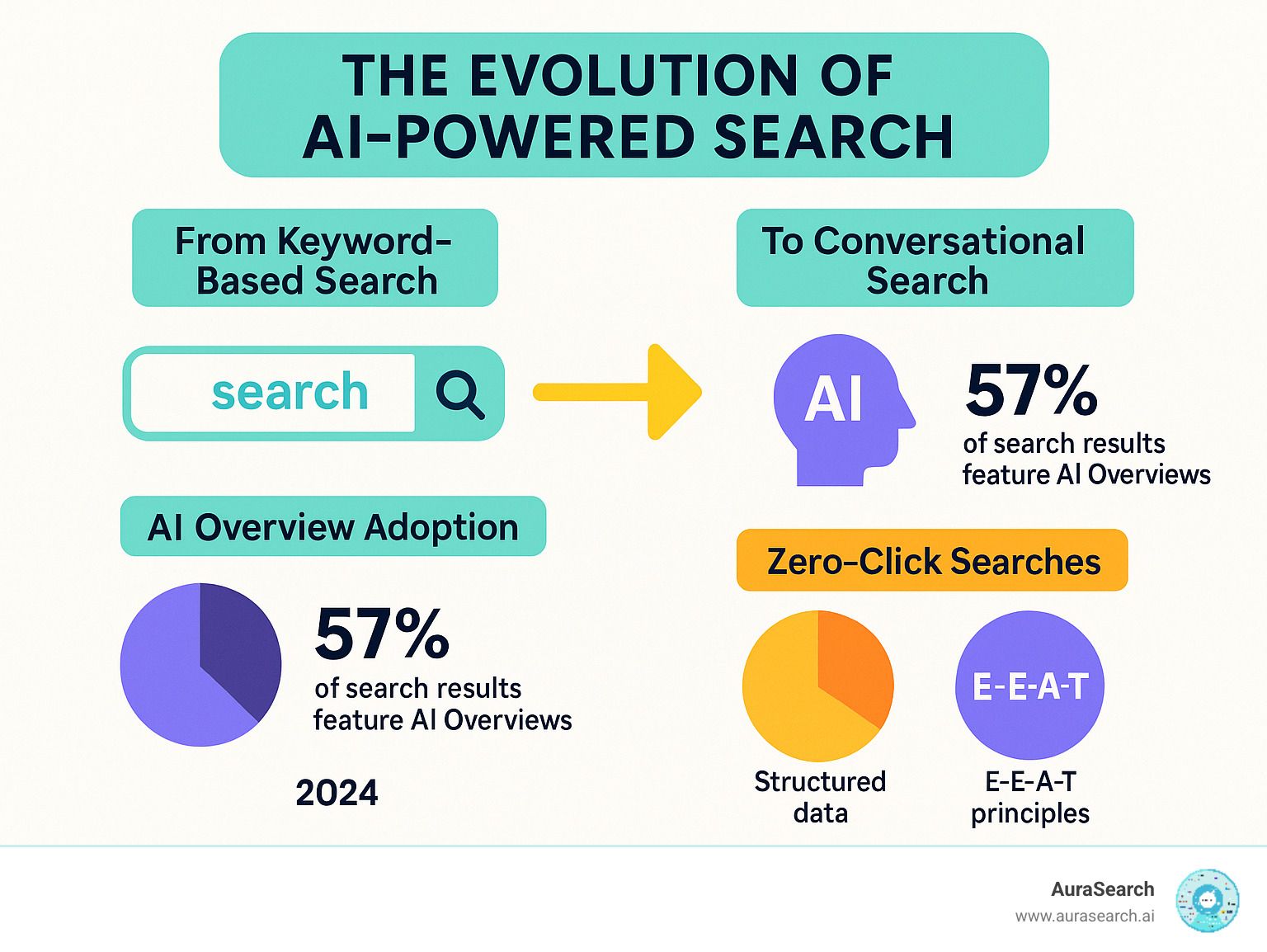
This shift has created something called zero-click searches . These happen when you get your answer right on the search results page without clicking through to any website. It might sound concerning for businesses, but here's the reality: in 2024, 60% of Google searches never left the search results page.
The rise of AI Overviews makes this trend even more significant. These AI-generated summaries now appear in a staggering 57% of SERPs, giving users instant answers pulled from multiple sources. Your content needs to work harder than ever to be part of these featured responses.
How AI Search Differs from Traditional Search
The old way of doing SEO feels almost quaint now. You'd pick some keywords, sprinkle them throughout your content, and hope for the best. AI search operates on completely different principles.
Semantic search has replaced simple keyword matching. AI understands relationships between concepts, so it can answer complex questions even when people phrase them differently. Instead of just showing you links, AI search provides direct answers and AI-generated summaries , pulling information from multiple sources to give you a comprehensive response right away. Source citation has become crucial in this new landscape, as AI platforms show where their information comes from. This means being a trusted, citable source is more valuable than ever. The entire user experience has shifted toward efficiency, meaning your content must be structured for AI to easily understand and extract key points.
Why AI Search Optimization is Crucial for Businesses
Ignoring AI search optimization today is like ignoring mobile optimization ten years ago. You might survive for a while, but you'll eventually get left behind.
Content visibility now depends on how well AI can understand and summarize your information. If your content isn't structured for AI interpretation, it simply won't appear in AI Overviews or get cited in AI-generated responses.
Smart businesses are future-proofing their strategy now. AI agents will soon make decisions for users, not just suggest options. Being part of those AI recommendations could make or break your business.
Authority building through E-E-A-T principles (Experience, Expertise, Authoritativeness, Trustworthiness) has never been more important. AI algorithms prioritize content from trusted sources, so establishing your credibility helps ensure your content gets referenced.
Adapting to the evolving search landscape means embracing both traditional SEO and new ai search optimization tools . Success requires understanding how AI interprets relevance, user intent, and content quality.
The search revolution isn't coming – it's here. The question is whether you'll adapt and thrive or watch from the sidelines. For more insights on navigating this new landscape, check out our AI SEO services and find how to optimize for the future of search.
Core Pillars of AI Search Optimization
Think of AI search optimization like building a house. You need a solid foundation, quality materials, and the trust of your neighbors. In the digital world, this translates to three essential pillars that make your content irresistible to both AI algorithms and human readers. These pillars are the difference between being buried in search results and becoming the go-to source that AI systems confidently cite.
Pillar 1: Create AI-Friendly, Human-First Content
The beautiful truth about AI search is that what makes humans happy usually makes AI happy too. Algorithms want what your readers want: clear, helpful, trustworthy content that answers their questions.
E-E-A-T (Experience, Expertise, Authoritativeness, and Trustworthiness) is the golden standard. Google's AI uses these signals to decide if your content deserves a spot in AI Overviews. You can learn more from Google's rater guidelines on E-E-A-T.
Featured snippets remain valuable, as AI Overviews often pull information from them. Provide direct, concise answers to common questions using long-tail keywords to increase your chances. Go beyond surface-level answers with in-depth explanations that anticipate follow-up questions.
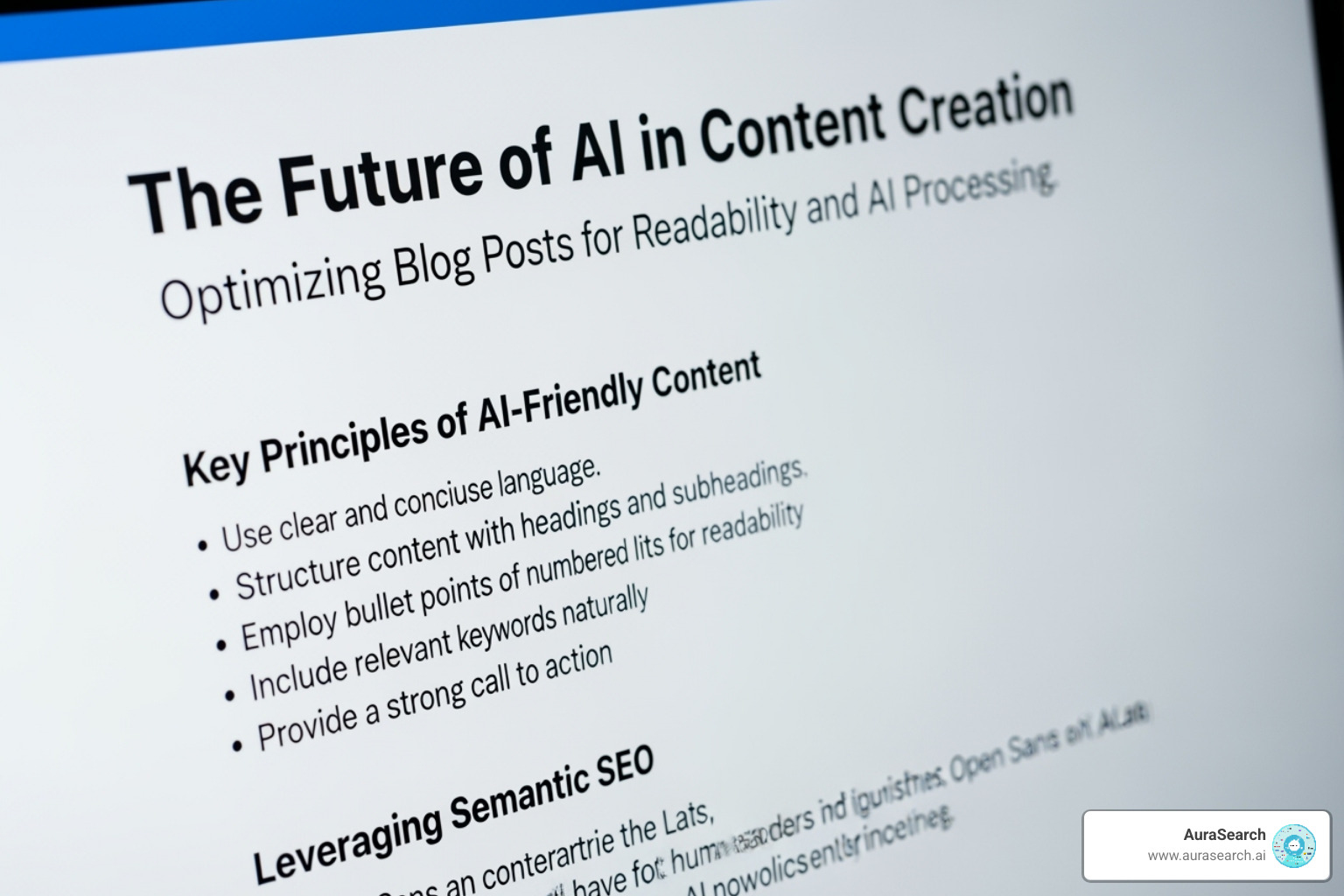
Clarity and readability are critical. Use short paragraphs, bullet points, and conversational language. Also, remember to update old content with fresh insights, as AI models are hungry for new information.
The best content formats for AI search include how-to guides, listicles, Q&A sections, and comprehensive articles because they are structured and easy for AI to extract information from.
Pillar 2: Implement Flawless Technical SEO
Even brilliant content will struggle if AI systems can't find or understand your website's technical foundation.
Structured data is your secret weapon. Using Schema.org markup gives AI a roadmap to your content, telling it explicitly what your page is about. This makes it far easier for ai search optimization tools to extract and present your information.
A solid technical base also includes essentials like fast page speed , mobile-friendliness , and HTTPS security . These factors improve user experience and signal trust to AI algorithms. Finally, ensure your robots.txt file and sitemaps are optimized so AI crawlers can find and index your content efficiently.

Pillar 3: Build Verifiable Authority and Trust
AI systems need to know who to trust. They are remarkably good at identifying genuine expertise, especially for YMYL topics (Your Money, Your Life).
Your author expertise must be visible and verifiable through detailed bios and credentials. High-quality backlinks from reputable sources act as endorsements, signaling your credibility to AI. Social proof and brand mentions across various platforms also contribute to your authority score.
Finally, demonstrating real experience through case studies and practical insights helps distinguish your content from generic information. Your entire online presence should consistently reinforce your expertise and trustworthiness.
Leveraging AI Search Optimization Tools: A Strategic Approach
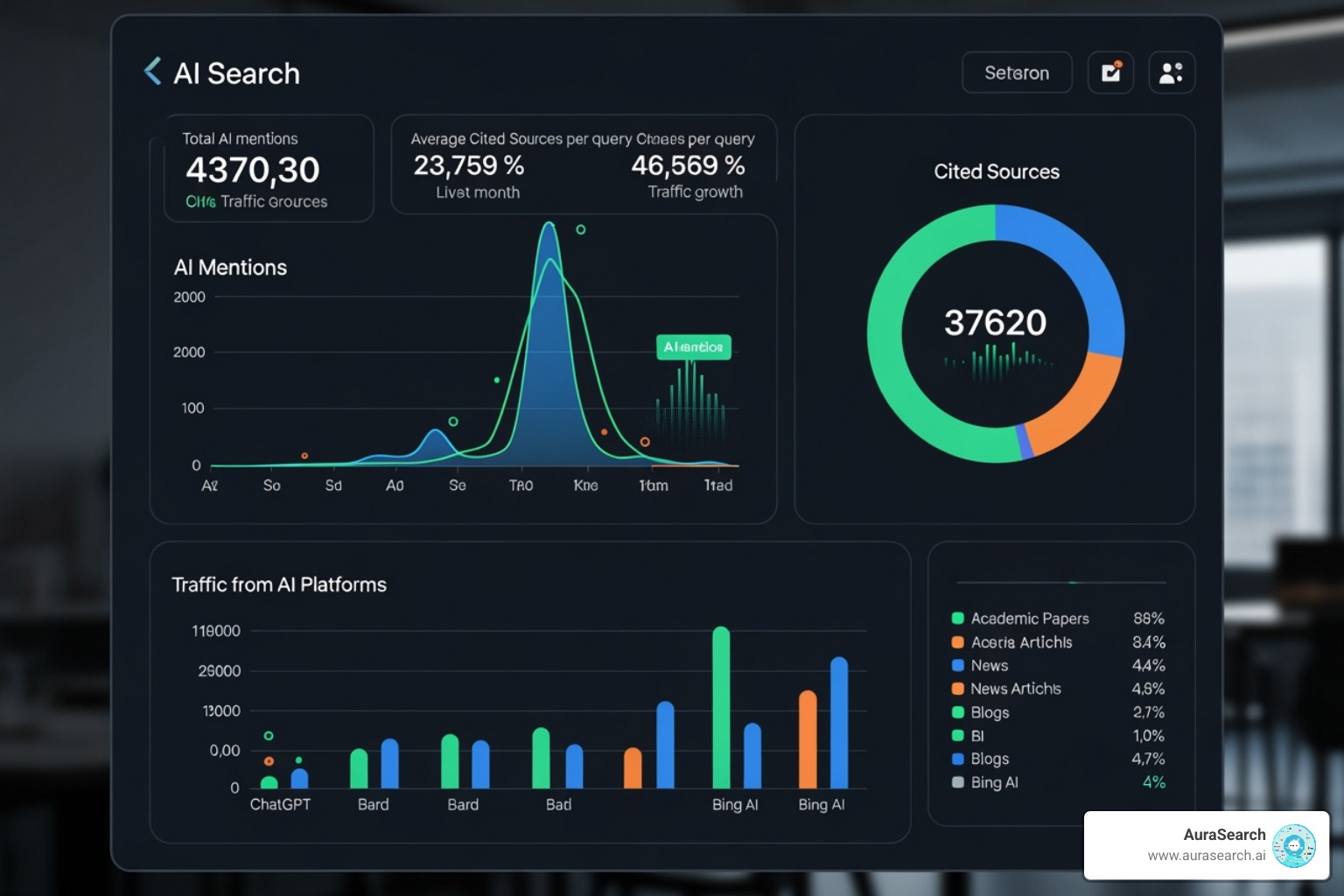
The world of search is changing fast, and keeping up manually is nearly impossible. That's where ai search optimization tools come in. These are essential for any business that wants to stay visible as AI reshapes how people find information. Think of these tools as digital assistants that automate workflows, spark content ideas, and turn mountains of data into actionable insights.
Choosing the Right Types of ai search optimization tools
The key to choosing the right tools is understanding what each type does and what you need it to do.
- Content creation platforms act like a writing assistant, helping you draft content, brainstorm outlines, and research topics efficiently.
- AI visibility trackers are a new and crucial category. They monitor where your brand appears in AI-generated answers from platforms like ChatGPT, Perplexity, and Google AI Overviews.
- Technical automation tools handle the crucial background tasks that make your site AI-friendly, such as optimizing metadata and ensuring fast indexing.
- Comprehensive platforms are the Swiss Army knives of AI search optimization, bundling content optimization, keyword research, site audits, and competitive analysis into one package.
When selecting tools, look for ones that integrate with your existing setup, provide specific insights about AI platforms, automate repetitive tasks, and support the E-E-A-T principles that AI algorithms value.
Practical Strategies for Using ai search optimization tools
These tools are powerful, but they work best when amplifying human expertise, not replacing it.
Use AI to accelerate research and drafting . Let AI handle routine tasks like writing schema markup or generating first drafts, freeing your team to focus on strategy, creative thinking, and adding unique insights. This turns days of manual analysis into minutes.
Analyze SERPs and AI Overviews to get a window into AI's decision-making process. These tools help you understand what content formats AI prefers and how often your content is being featured.
Monitor brand mentions in LLMs to understand the narrative AI is creating about your business. Regularly checking how platforms like ChatGPT and Perplexity reference your brand is essential for reputation management.
Finally, use tools to A/B test titles and summaries . Experiment with different approaches to see what resonates with both AI algorithms and real users, helping you increase click-through rates and your chances of being cited.
The Future of Search: Risks, Rewards, and What's Next
The search world is racing toward an era where Generative Engine Optimization (GEO) becomes the new standard. AI agents will do more than just suggest information—they'll actively make decisions for people, from booking flights to ordering groceries. This shift means your business needs to be the preferred choice when an AI makes these decisions on behalf of your customers.

The stakes are getting higher, but so are the rewards. Businesses that understand how to position themselves in this AI-driven landscape will capture new traffic and customers. The key is proactive optimization —getting ahead of these changes rather than scrambling to catch up.
Navigating the Risks and Limitations
The AI revolution isn't without its challenges. The biggest trap is thinking AI can replace good judgment. AI-generated content spam is a real problem, and Google's message is clear through its guidance on AI content : using AI primarily to manipulate rankings violates spam policies.
Factual inaccuracies , or "hallucinations," are another challenge. AI models can generate information that sounds convincing but is wrong. This is why human oversight is essential. No AI tool should publish content without a human reviewing it for accuracy. Over-reliance on automation is also a risk; AI should improve human expertise, not replace it. The most helpful content that serves user intent will always win, regardless of how it was created.
Preparing for the Next Wave of AI
Smart businesses are already preparing for what's next. Securing a first-mover advantage is critical. Mathematical principles like Benford's Law suggest that initial positions in rankings get referenced disproportionately more often. In the AI world, this creates a snowball effect: if your content is cited first, it's more likely to be cited again.
The continued growth of voice search means your content needs to be conversational and answer questions naturally. Hyper-personalization is also on the horizon, with AI tailoring results to individual users.
The most important preparation strategy is continuous learning and adaptation . The AI landscape changes rapidly. Staying informed and experimenting with new strategies will separate the leaders from the followers.
Frequently Asked Questions about AI Search Optimization
Let's tackle the most common questions we hear about AI search optimization.
Is AI-generated content bad for SEO?
No, AI-generated content isn't inherently bad for SEO . Google's official guidance is clear: they care about the quality and helpfulness of the content, not how it was created. Studies have found no negative ranking impact from using AI.
The real question is whether your content is original, helpful, trustworthy, and aligned with search intent . If AI helps you create valuable content that solves user problems, it's perfectly fine. However, using AI to generate thin, low-quality content simply to manipulate rankings is considered spam. The key is human oversight: always review, fact-check, and add your unique perspective to any AI-generated text.
How do I optimize for Google's AI Overviews?
Optimizing for AI Overviews requires a focus on credibility and clarity.
- Start with E-E-A-T principles (Experience, Expertise, Authoritativeness, Trustworthiness) to build credibility.
- Structure content for clarity with short paragraphs, bullet points, and direct answers to questions.
- Implement structured data (Schema markup) to help AI understand your content's context.
- Provide comprehensive information that anticipates and answers follow-up questions.
- Optimize for featured snippets , as AI Overviews often draw from them.
- Focus on conversational, long-tail queries that mirror how people speak to AI assistants.
Will AI replace the need for SEO professionals?
No, but the role is evolving. AI won't replace SEO professionals any more than calculators replaced accountants. Instead, it's making us more strategic and effective.
AI excels at automating repetitive tasks like research and drafting, but it lacks the human intuition, creativity, and strategic thinking required for true success. SEO professionals are becoming "AI strategists" who audit AI outputs, design comprehensive content strategies, and interpret complex data .
The human element is more valuable than ever for understanding nuanced user intent and adapting to algorithm changes. AI is a powerful assistant, not a replacement. The professionals who accept it will thrive.
Conclusion
The generative era has arrived. When 57% of search results now feature AI Overviews and platforms like ChatGPT handle millions of daily queries, the future of content visibility depends on how well AI can understand and present your information.
This is a fundamental shift creating winners and losers right now. Businesses adapting to this change are gaining a significant competitive advantage.
We've covered the three core pillars for success: creating human-first, AI-friendly content; implementing flawless technical SEO; and building verifiable authority that AI algorithms trust. The ai search optimization tools we've discussed are essential for monitoring visibility and ensuring your content appears when AI agents make decisions for users. This is the core of Generative Engine Optimization (GEO) .
This change is happening whether we participate or not. The question isn't if AI will change search—it already has. The question is whether you'll be ready when your customers get their answers from AI.
At AuraSearch , we've been preparing for this moment. We understand that adapting to the AI-driven search landscape requires a complete rethinking of content, technical optimization, and authority building.
The future of digital marketing is here. Don't let this opportunity pass you by.