Why AI-Powered Search is Changing Everything

How to optimize content for generative ai has become the most critical question for marketers. As AI tools like ChatGPT, Google's AI Overviews, and Perplexity reshape information findy, traditional SEO is no longer enough.
Quick Answer: To optimize content for generative AI:
- Write conversationally using natural language and Q&A formats.
- Structure content clearly with descriptive headings and bullet points.
- Include citations and statistics to boost credibility by up to 40%.
- Focus on E-E-A-T signals (Experience, Expertise, Authoritativeness, Trustworthiness).
- Use schema markup to help AI understand your content's context.
- Create comprehensive answers that directly address user questions.
- Build topical authority through consistent, expert-level content.
The numbers are stark: AI Overviews correlate with a 34.5% drop in average click-through rates for the #1 search result, while Plausible Analytics reported a 2200% increase from AI traffic sources in 2024. This isn't just an algorithm update; it's a fundamental shift. With 70% of Gen Z now preferring AI answers and Gartner predicting a 25% drop in traditional search volume by 2026 , the challenge is clear. Content ranking well in Google may be invisible to AI. The opportunity lies in mastering Generative Engine Optimization (GEO) to dominate this new landscape.
The Shift to Generative Search: Why GEO is Your New SEO
The era of topping Google's first page is ending. We're in the biggest search evolution since Google's launch, and it's happening faster than most businesses realize.
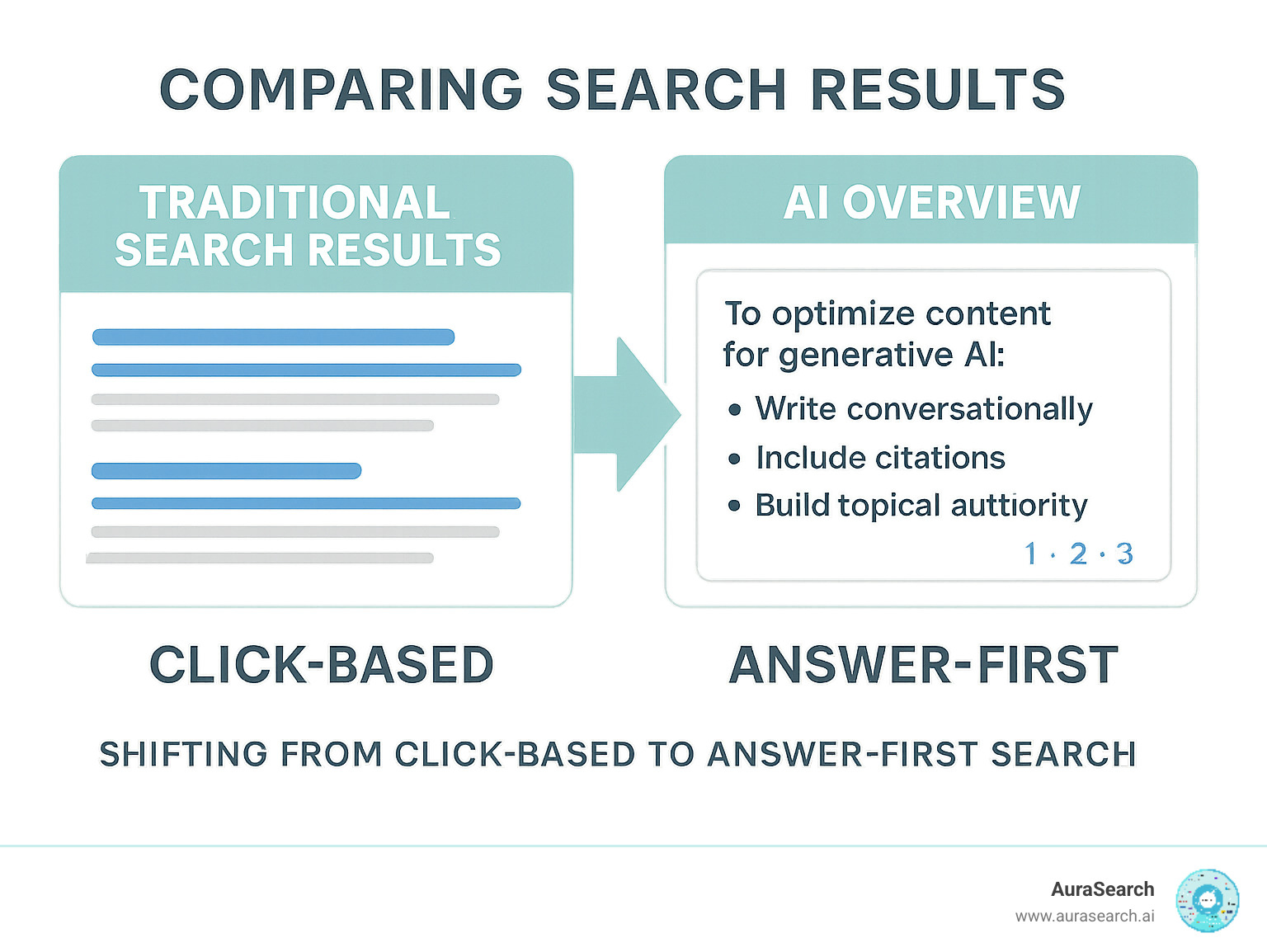
The game has fundamentally changed. AI-powered search engines like ChatGPT and Google's Gemini are rewriting the rulebook. Instead of a list of blue links, these AI systems directly answer questions by synthesizing information from multiple sources into comprehensive responses.
This shift has created Generative Engine Optimization, or GEO. Think of it as SEO's evolution, designed for the age of AI.
So what exactly is GEO? It's the practice of making your content not just findable, but quotable by AI systems. While SEO targets high rankings for clicks, GEO ensures AI platforms understand, trust, and cite your content in their answers. GEO is like having AI systems recommend your business directly to customers.
| Feature | Traditional SEO | Generative Engine Optimization (GEO) |
|---|---|---|
| Primary Goal | Rank high in SERPs, maximize clicks to website | Be cited/referenced in AI-generated answers/summaries |
| Content Focus | Keyword-rich, structured for readability & crawl | Contextually relevant, comprehensive, answer-focused, clear |
| Ranking Factors | Keywords, backlinks, domain authority, site speed | E-E-A-T, semantic understanding, data/citations, clarity, structure |
| User Experience | Leads users to website for information | Provides direct answers within AI interface, reduces clicks |
| Metrics | Clicks, impressions, conversions, rankings | AI Answer Inclusion Rate, Attribution Frequency, Brand Mentions in AI |
| Content Output | List of blue links | Synthesized answers, summaries, recommendations |
Understanding AI Search Engines and How They Process Information
Traditional search engines act like librarians, cataloging and listing web pages. AI search engines are more like research assistants that synthesize information from multiple sources to create new, custom responses. As Stephen Wolfram explains in his deep-dive What Is ChatGPT Doing … and Why Does It Work? , these systems predict the most likely next word based on massive datasets, creating human-like responses.
When you ask an AI a question, it uses Natural Language Processing to understand your intent. It then combines its training data with real-time web searches to craft a direct answer. This means your content is selected based on clarity, factual accuracy, and how directly it answers the user's question, rather than just traditional ranking signals like backlinks.
The Impact of AI Overviews and Zero-Click Searches
AI Overviews and zero-click searches present a significant challenge.

We're seeing a 34.5% drop in click-through rates for the #1 search result when AI Overviews appear. Users get their answers directly from AI, often without visiting your website. This creates the "seen but not visited" phenomenon. Your content might power the AI's response, building brand authority, but you won't see the direct traffic you're used to. The user journey has compressed from "search, click, read" to simply "ask and receive."
Why Generative Engine Optimization (GEO) is Crucial for Business
While the shift is rapid, businesses that adapt to GEO will gain a massive competitive advantage. Gartner predicts a 25% drop in traditional search volume by 2026 , making GEO essential for future-proofing your business.
When AI systems consistently cite your content, you receive an implicit endorsement from a trusted source. This builds brand visibility and establishes your authority in ways traditional advertising cannot. People recognize your company's expertise, even if they consume it through an AI interface.
This credibility boost is powerful; it's like getting a stamp of approval from the world's most well-read research assistant. Early adopters will dominate this space. The brands that master GEO now will set the standard for years to come.
Core Principles: How to Align with AI's Ranking Logic
Optimizing for generative AI isn't about gaming a system; it's about aligning with how AI evaluates quality and relevance. AI systems function like a trusted, knowledgeable friend, and they assess expertise through specific signals we can optimize for.
The foundation of GEO rests on two principles: Google's E-E-A-T standards and a deep understanding of search intent . Mastering these will help your content surface in AI-generated responses.
Mastering E-E-A-T for AI Visibility
Google's E-E-A-T guidelines—Experience, Expertise, Authoritativeness, and Trustworthiness—are the backbone of successful GEO. AI systems are trained to prioritize reliable information, making E-E-A-T your secret weapon.

- Experience: Show you've actually done what you're talking about. Share real-world case studies and personal examples, not just generic advice. AI can detect genuine knowledge.
- Expertise: Feature qualified authors and provide deep technical details. AI favors content that demonstrates a thorough understanding, not surface-level explanations.
- Authoritativeness: Build this through external validation like industry mentions and expert quotes. This creates the recognition that AI systems value.
- Trustworthiness: Be transparent with data sources, ensure accuracy, and maintain site security. AI avoids citing questionable sources.
Focusing on E-E-A-T creates a virtuous cycle: better content gets referenced by AI, which further builds your authority. We explore these strategies in more detail on our AuraSearch AI SEO blog.
Decoding Search Intent for Generative Queries
AI understands context and intent, not just keywords. It analyzes why a user is asking a question to provide the most helpful answer.
- Informational intent drives most AI queries. Create comprehensive, fact-based content with clear answers and citations.
- Commercial investigation involves users researching before a purchase. Comparative listicles perform well here, accounting for 32.5% of all sources cited by AI systems.
- Navigational queries help users find specific sites. Clear branding and site architecture are key.
- Transactional intent captures users ready to act. Include clear calls to action and pricing information.
The key is to focus on how real people ask questions, using natural, conversational language rather than rigid keyword phrases.
How AI Search Engines Choose and Cite Sources
AI systems follow logical patterns when selecting sources. Understanding these provides a roadmap for optimization.
- Content clarity: Well-organized, jargon-free content is cited more often because it's easier for AI to parse and summarize.
- Statistical relevance: Content backed by verifiable data and specific statistics performs dramatically better. GEO methods using concrete stats can boost source visibility by over 40% .
- Community mentions: Positive discussion on platforms like Reddit signals real-world relevance and authority to AI models.
- Unique insights: Original research, expert interviews, and distinctive perspectives give AI something worth citing rather than just synthesizing from generic sources.
Content types that consistently surface in AI responses include comparative listicles, in-depth guides, expert blog posts, and structured FAQ sections.
Your Playbook: How to Optimize Content for Generative AI
Now, let's dive into the practical strategies for how to optimize content for generative ai . This involves adapting your content strategy, writing style, and structure to communicate effectively with AI systems.
Adapting Keyword Research: How to Optimize Content for Generative AI
GEO requires a shift from traditional keyword research:
- Focus on Long-Tail & Conversational Keywords: Target natural, question-based phrases like "What are the best SEO tools for small businesses?" This reflects how people speak to AI.
- Semantic Keywords: Move beyond exact matches to include related terms and concepts. Use tools to identify topical clusters.
- Question-Based Queries: Build content around directly answering common audience questions, often using FAQ sections. As Riccardo Buzzotta of ContentRadar notes, LLMs excel at triangulating the right questions.
The Importance of Content Structure, Clarity, and Authority
AI crawlers value well-structured, clear content that is easy to parse.
- Descriptive Headers (H1-H6): Use clear headings to outline your content's structure, acting as signposts for AI.
- Short Paragraphs & Bullet Points: Break down information into digestible chunks, making it easier for AI to extract key information.
- Citing Reputable Sources & Including Statistics: Back up claims with data. A recent GEO study found that verifiable citations and stats can boost a page’s citation share by up to 41% .
- Provide Concise Answers: Start sections with a direct, summary-style answer to the question posed by the heading.

The Human Touch: How to Optimize Content for Generative AI with Originality
While AI can generate content, it can't replicate genuine experience or unique insights. This human element is your secret weapon.
- First-Hand Experiences: Share your unique stories, case studies, and practical applications.
- Unique Frameworks: Develop and present original models or methodologies. AI is more likely to cite your original source.
- Expert Quotes & Personal Case Studies: Integrate quotes from recognized experts and detail specific brand successes or challenges.
- Brand Voice & Personality: Maintain a consistent, authentic brand voice to stand out. Humanized content can lead to a 30% increase in reader trust , a quality AI aims to reflect.
Enhancing Content with Multimedia and Video SEO
Multimedia improves user engagement and provides additional signals for AI.
- Engaging Images & Infographics: Use relevant, high-quality visuals with descriptive alt text, as AI can increasingly understand visual context.
- Explainer Videos: Publish videos on YouTube, a significant source for AI. Optimize them with search-friendly titles, descriptions, and transcripts.
- Video Transcripts: Provide full transcripts for all videos to make your video content crawlable and searchable by AI.
Technical Foundations: Making Your Site AI-Crawler Friendly
Beyond content, your website's technical health is vital. A technically sound site acts as a clear roadmap, ensuring AI crawlers can access, understand, and cite your valuable information.
Using Structured Data and Schema Markup to Communicate with AI
Structured data and schema markup act as a universal translator for AI crawlers, helping them grasp your content's context with precision. This is a crucial technical piece when you optimize content for generative ai .
By implementing specific Schema.org types
—like Article
, FAQPage
, HowTo
, or Product
—you directly tell AI what kind of content it's looking at. We recommend using the JSON-LD format
, as it's Google's preferred method and is efficient for AI to process. Marking up elements like the author, publication date, or reviews gives AI rich context, significantly increasing the chances your content will be accurately cited.

Optimizing Site Architecture and Internal Linking
A well-structured site architecture makes it easy for AI crawlers to find and value your content. Organizing content into topical silos —grouping related articles around a central pillar page—demonstrates comprehensive expertise.
Logical navigation and an intelligent internal linking strategy are also key. Connecting related content passes authority between pages and helps AI understand the depth of your knowledge. This signals your E-E-A-T by showcasing a cohesive knowledge base. Adding breadcrumbs provides an extra layer of clarity, indicating a page's location within your site's hierarchy.
Managing AI Crawlers: robots.txt and the new llms.txt
Managing AI bots via your robots.txt
file is crucial for visibility. For optimal GEO, ensure legitimate AI crawlers like GPTBot
(OpenAI), Google-Extended
(Google), and ClaudeBot
(Anthropic) can access your public content. You might consider disallowing general training bots like ccbot
(Common Crawl). You can find more guidance on managing Google's AI crawlers in their official documentation.
Also, keep an eye on emerging standards like llms.txt
, a proposed specification to give you more granular control over how LLMs use your content.
Finally, consider your crawl budget . AI crawlers now make up about 28% of Googlebot's volume but can be 47 times less efficient than traditional crawlers, with 34% of their requests resulting in errors . This highlights the need for a fast, clean website with simple HTML, as many AI crawlers struggle with JavaScript-heavy sites. A smooth crawl means a better chance for your content to shine.
Measuring and Monitoring Your GEO Success
How do you know if your GEO efforts are working? Traditional SEO metrics are insufficient; we need to adopt AI-centric metrics to truly understand our success and refine our strategy. We need to measure not just clicks, but visibility, attribution, and influence within new AI-driven environments.
Key Metrics for Tracking GEO Performance
To measure GEO success, look beyond click-through rates to signals of AI inclusion and influence.
- AI Referral Traffic: This is direct traffic from AI platforms like Perplexity. Some reports show a 2200% increase from these sources, highlighting their growing importance.
- Branded Search Volume: An increase in users searching directly for your brand after seeing it in an AI answer is a powerful indirect signal of impact.
- Appearance in AI Overviews/GenAI Results: This is the most direct measure: how often is your content cited or summarized in AI answers? Emerging tools can track this "AI footprint."
- Conversions from AI: Track if users who encounter your brand via AI later convert through other channels. This requires a sophisticated attribution model but is essential for understanding ROI.
- LLM Inclusion Rate: This measures how frequently your content is selected by Large Language Models to formulate responses, a direct nod to your information's quality.
- Sentiment Analysis: Monitor how your brand is portrayed in LLM responses to manage your narrative and ensure a positive perception.
Tools and Techniques for Monitoring AI Visibility
Monitoring your content's visibility and brand sentiment within LLMs requires a blend of manual checks and new tools.
- Prompt Testing in Major Engines: Regularly test prompts related to your brand and content in tools like ChatGPT, Google's Gemini, and Perplexity to find direct citations or summaries of your work.
- Brand Mention Tracking: Use tools that can pick up mentions of your brand within AI-generated responses.
- AI Visibility Reports: Look for new platforms that measure how frequently your brand appears in AI results and how accurately it's described.
- Manual Reverse-Tracking: Search for unique phrases or data points from your content within AI tools to see if it's being used without direct citation.
- Monitor Server Logs:
Check for visits from AI crawler user-agents like
GPTBotorGoogle-Extendedto confirm that AI bots are seeing your content. - Correcting Misinformation: If you find AI misrepresenting your brand, create "correction pages" on your site to provide accurate information.
To get a baseline, you can also check out resources like HubSpot's AI Search Grader to see how well your content is currently optimized for AI search.
Frequently Asked Questions about Optimizing for Generative AI
Here are clear, practical answers to the most common questions about this new AI-powered search landscape.
What is the difference between SEO and GEO?
Think of SEO as getting listed in a directory, while GEO is getting a direct recommendation.
SEO (Search Engine Optimization) targets high rankings and clicks in traditional link-based search results. It focuses on signals like keywords and backlinks.
GEO (Generative Engine Optimization) targets citation and reference within AI-generated answers. It prioritizes clarity, E-E-A-T signals, and structured data. The goal shifts from driving clicks to becoming a trusted source for AI, even if users don't visit your site.
This doesn't mean SEO is dead; both strategies are needed to capture the full spectrum of how people find information today.
What types of content perform best in AI search?
AI favors well-structured content that provides clear, comprehensive answers. The best-performing types include:
- Comparative listicles: These account for about 32.5% of all sources cited by AI because they offer clear, structured comparisons.
- In-depth guides: Comprehensive resources that thoroughly address user questions are highly valued.
- Articles with strong data and statistics: AI prioritizes content that backs up claims with verifiable facts, like a "34.5% drop in CTR."
- Content with unique expert insights: Your personal case studies and first-hand experiences are valuable because AI cannot replicate authentic expertise.
The common thread is that AI favors content that is well-organized and easy for it to understand and extract key information from efficiently.
How can I track if my content is being used by AI?
Tracking methods are still evolving, but several reliable techniques exist now:
- Monitor server logs:
Look for visits from AI crawler user-agents like
GPTBot(OpenAI),Google-Extended(Google), andClaudeBot(Anthropic). - Check analytics: Look for referral traffic from AI platforms like Perplexity AI. Plausible Analytics reported a 2200% jump in such traffic in 2024.
- Manual testing: Regularly test prompts related to your brand in major AI tools (ChatGPT, AI Overviews, Perplexity) to find direct citations or summaries of your work.
- Watch for indirect signals: An uptick in branded searches after AI Overviews appear for your industry terms can mean users saw your brand in an AI summary.
- Use source-citing tools: Tools like Perplexity show direct source links, making it easy to see when your content is cited.
Conclusion
Optimizing for generative AI is no longer optional—it's essential for your brand's future. This new digital frontier requires a different approach than the SEO we've known for years.
We've covered the shift from traditional SEO to Generative Engine Optimization (GEO), the importance of E-E-A-T, understanding user intent, and the technical foundations needed to succeed. While "zero-click searches" may sound intimidating, they open new avenues for brands ready to adapt.
It's all about being proactive. By creating content that is clear, trustworthy, and human-centric—backed by a solid technical setup and smart monitoring—you ensure your voice is heard where it counts. Here at AuraSearch AI, we specialize in generative AI SEO and are passionate about helping businesses like yours not just adapt, but shine in this evolving AI-driven world.
Are you ready to lead the charge in the AI-driven search revolution? We'd be thrilled to help you get started.