Understanding Content Optimization in the Age of AI Search

Content optimization is the process of improving your website's pages, blog posts, and digital assets to rank higher in search engines, engage your audience, and drive meaningful results. It's not just about stuffing keywords into your content—it's about creating material that serves both human readers and the algorithms that decide what content deserves visibility.
Quick answer: Content optimization involves:
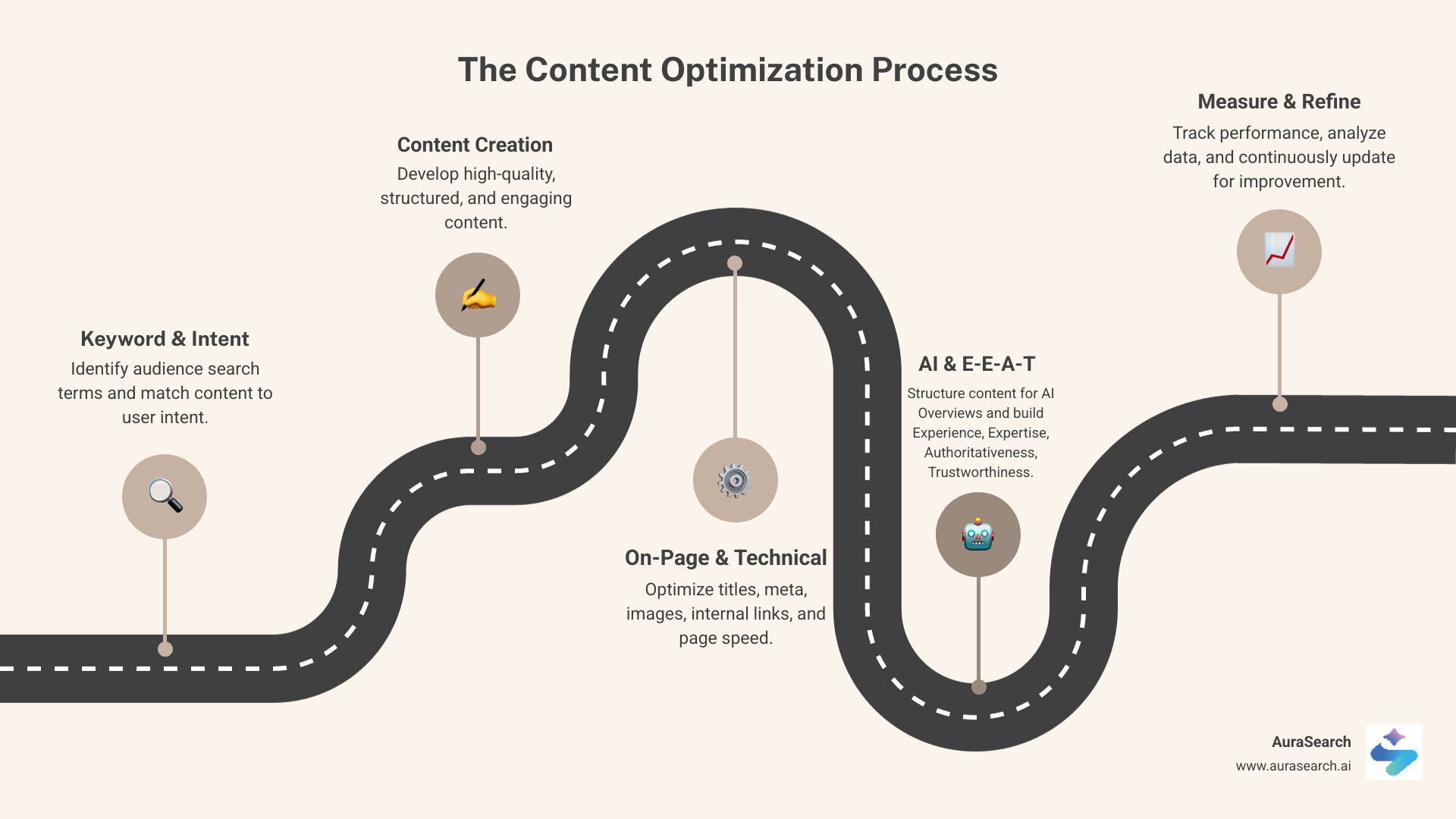
- Keyword research to understand what your audience searches for
- Matching search intent so your content answers the right questions
- Structuring content with clear headings, short paragraphs, and scannable text
- On-page SEO including title tags, meta descriptions, and internal links
- Content freshness through regular updates and improvements
- E-E-A-T signals (Experience, Expertise, Authoritativeness, Trustworthiness)
- AI-friendly formatting to appear in AI Overviews and chatbot responses
If you've noticed your organic traffic declining despite good rankings, or if you're struggling to appear in ChatGPT, Perplexity, or Google's AI Overviews, you're facing the same challenge as 88% of businesses worried about losing visibility in AI-driven search.
The landscape has shifted dramatically. When a generative AI summary appears on the search results page, users click traditional result links only about 8% of the time. This means your content needs to work harder—not just to rank, but to be cited, featured, and trusted by AI systems that are reshaping how people find information.
The good news? Content optimization gives you a clear path forward. By understanding both traditional SEO principles and the new requirements of AI search platforms, you can create content that performs in both worlds. This guide will show you exactly how to do that, with actionable steps backed by data and real-world results.
Quick content optimization terms:
- ai-driven content optimization
- ai content optimization strategies
The Core Pillars of Effective Content Optimization
At its heart, content optimization is a continuous process of refining and updating your digital assets to achieve specific goals, whether that's ranking highly in search results, driving conversions, or being cited by an AI. It's an important component of a broader SEO strategy, focusing on the actual words, images, and structure that make up your web pages.
The primary goal is to improve your content's visibility in both traditional search engines and emerging AI tools. This involves several key elements:
- Search Intent: Understanding what users truly want when they type a query.
- Content Quality: Creating comprehensive, valuable, and engaging material.
- On-Page SEO: Ensuring all elements on the page are optimized for search engines.
- E-E-A-T: Demonstrating Experience, Expertise, Authoritativeness, and Trustworthiness.
- Content Freshness: Keeping your information accurate and up-to-date, as AI tools show a strong preference for recent content.
As Google's own documentation stresses, creating helpful, reliable, and expert-driven content is paramount. A recent study on Generative Engine Optimization (GEO) further highlights this, finding that content featuring expert quotes, proprietary data, and natural writing has a higher chance of appearing in AI outputs. This means that focusing on these pillars not only helps your traditional SEO but also paves the way for AI visibility.
Mastering Keyword Research and Search Intent
Before you even write a single word, understanding your audience's needs is crucial. This begins with thorough keyword research and search intent analysis.
Keyword Research involves identifying the words and phrases your target audience uses when searching for information related to your content. It's pointless to optimize for keywords with no search volume. We aim to find both:
- Primary Keywords: The main term you want your content to rank for.
- Secondary Keywords: Related terms that provide additional context and help search engines understand the breadth of your topic.
- Long-Tail Keywords: More specific, often longer phrases that indicate a more defined user need, typically leading to higher conversion rates.
Once we have our keywords, we dive into Search Intent . Google prioritizes content that directly addresses what a user is trying to accomplish. There are four main types of search intent:
- Informational: The user wants to learn something (e.g., "how to bake sourdough bread").
- Navigational: The user is looking for a specific website or page (e.g., "AuraSearch login").
- Commercial Investigation: The user is researching products or services before making a purchase (e.g., "best AI SEO services review").
- Transactional: The user is ready to make a purchase or complete an action (e.g., "buy AI SEO software").
We determine search intent by reviewing top-ranking content for a query, looking at the type of content (e.g., blog post, product page), its format (e.g., listicle, guide), and its angle. This analysis helps us create content that truly satisfies the user's need. Additionally, a content gap analysis can reveal topics or questions that top-ranking content might be missing, giving us an opportunity to provide more comprehensive answers.
Crafting High-Quality, Readable Content
Even the most perfectly keyword-optimized content won't succeed if it's not high-quality and easy to read. Online readers prefer content that is easily digestible, and Google favors websites with clear, well-organized material. In fact, a survey found that 43% of marketers and SEOs prioritize readability to improve both SEO and conversions .
To craft content that truly shines:
- Structure with Purpose: Use a clear hierarchy of headings (H1, H2, H3, etc.) to break up text and guide readers. Bullet points, numbered lists, and bold text make content scannable. We often apply the "Bottom Line Up Front" (BLUF) method, presenting the most crucial information early on.
- Concise Language: Write in an active voice and avoid jargon or filler words. Reading your content aloud can help you check its narrative flow and identify awkward phrasing. Writing assistants can also help improve clarity, conciseness, and engagement.
- Short Paragraphs: Large blocks of text can be intimidating. Break your content into short, digestible paragraphs, ideally no more than 3-4 sentences.
- Readability Scores: Aim for a readability score of grade level 9 or below. This ensures your content is accessible to a broader audience and easier for both humans and AI to process.

For more insights on making your content compelling, check out our Tips for Writing Great Posts That Increase Your Site Traffic.
Essential On-Page and Technical Elements for Content Optimization
Beyond the words on the page, several on-page and technical elements play a critical role in content optimization . These signals help search engines understand what your content is about and how well it performs for users.
- Title Tags: These define the main topic of your page and appear in browser tabs and search results. They should be concise, include your primary keyword, and entice clicks.
- Meta Descriptions: A brief summary of your page's content that appears under the title in search results. While not a direct ranking factor, a compelling meta description can significantly improve your Click-Through Rate (CTR).
- Image Alt Text: Descriptive text that explains the content of an image. This is crucial for accessibility (screen readers) and helps search engines understand visual content. We also ensure image file names are descriptive and keyword-rich, and we compress image files to reduce sizes without losing quality, helping with page speed.
- Internal Linking: Linking to other relevant pages on your site helps users steer and keeps them engaged longer. It also distributes "link equity" and signals to search engines the relationship between your content pieces. This is an often-overlooked but powerful optimization tactic.
- URL Structure: Clear, descriptive URLs that include relevant keywords help both users and search engines understand the page's topic.
The technical foundation of your website also profoundly impacts content performance:
- Mobile-First Indexing: This is non-negotiable. Over half of web traffic comes from mobile devices , and Google uses mobile-first indexing , meaning its crawlers prioritize the mobile version of your site. If your content isn't optimized for mobile, it could hurt your rankings.
- Page Speed: Google considers page experience signals, including Core Web Vitals, which measure the speed and visual stability of your pages. We ensure content loads quickly by optimizing images, minimizing code, and leveraging efficient hosting. A slow site frustrates users and search engines alike.
The AI Revolution: Optimizing for Generative Search
The rise of Large Language Models (LLMs) and generative AI, exemplified by Google's AI Overviews and chatbots like ChatGPT, has fundamentally reshaped search. We're no longer just optimizing for blue links; we're optimizing to be cited by AI systems. This new landscape brings both challenges and immense opportunities.
As we noted in the introduction, 88% of businesses are worried about losing organic visibility in AI-driven search. This concern is well-founded: when a generative AI summary appears on the SERP, users click traditional result links only about 8% of the time. This dramatic shift means content needs to be structured not just for human readers and traditional crawlers, but also for AI systems that summarize, excerpt, and cite information.
What is Generative Engine Optimization (GEO)?
Generative Engine Optimization (GEO) is our answer to this evolving challenge. It's the specialized process of optimizing content to be selected as a source by AI-generated answers in platforms like Google AI Overviews, ChatGPT, and Perplexity. Think of it as a sophisticated form of Answer Engine Optimization (AEO) , where our goal is to provide clear, direct, and definitive answers that AI can easily extract and reference.
GEO helps content get selected as a source in AI-generated answers by structuring and optimizing it so AI tools can interpret, evaluate, and reference it effectively.
Key aspects of GEO include:
- Conversational Queries: AI tools excel at understanding natural language questions. We optimize content to directly answer these conversational queries, using phrasing similar to what users type into AI systems.
- Direct Answers: AI systems favor content that provides definitive answers clearly and concisely, often within the first few sentences or paragraphs.
- AI-Friendly Structure: This involves a short, concise introduction, followed by a direct answer immediately after a heading. We use explicit, question-based headings (e.g., "What is...", "How does...", "Why does...") and incorporate bulleted/numbered lists and concise FAQs. Adding a 1-2 sentence TL;DR (Too Long; Didn't Read) summary under key H2s can also significantly increase the likelihood of AI citation.

A recent study on Generative Engine Optimization (GEO) found that content featuring expert quotes, proprietary data, and natural writing has a higher chance of appearing in AI outputs. This reinforces the need for high-quality, authoritative content in the AI era.
To dig deeper into this critical area, Learn more about Generative Engine Optimisation and explore the Recent study on GEO.
Using Structured Data to Signal Trust to AI
Structured data, often implemented using schema markup , is a powerful way to communicate the meaning and context of your content directly to search engines and AI systems. It's like giving AI a cheat sheet for understanding your page.
Structured data signals meaning and credibility to AI-driven search systems, helping them quickly identify the source, scope, and authority of content, which is crucial for citation decisions. Its absence can make content less likely to be included in generative search environments.
Here are some common types of schema markup we use:
- Article Schema: For blog posts, news articles, and guides, this markup provides details like author, publication date, and headline, enhancing visibility in rich results.
- FAQ Schema: If your content includes a list of frequently asked questions and answers, this schema can make them eligible for direct display in search results, including AI Overviews.
- Review Schema: For product or service pages with reviews, this markup can display star ratings and other review details directly in the SERP, making your content stand out. Read more here about review snippets.
- Organization and Author/Person Schema: These markups establish the identity and credentials of your organization and content creators, which are vital for E-E-A-T signals.
By implementing relevant structured data, we help AI systems quickly and accurately interpret your content, increasing its chances of being cited and contributing to the Knowledge Graph. This is a subtle yet impactful form of content optimization for the AI era.
For more on optimizing for AI search, explore More on AI Overview Optimisation.
Why AI Prefers Fresh, Authoritative Content
In the digital world, content freshness and authority are more critical than ever, especially for AI visibility. AI systems are designed to provide the most current and reliable information available.
Consider this: a Seer Interactive study found that almost 90% of AI bot activity focused on content published within the past three years, with the strongest preference for pages updated between 2023 and 2025. Both Google and AI systems like ChatGPT and Perplexity prefer newer sources, understanding that information can quickly become outdated. Regularly refreshing content signals reliability to readers and AI tools alike.
This brings us back to E-E-A-T : Experience, Expertise, Authoritativeness, and Trustworthiness. These signals are crucial for both traditional search rankings and AI citations. To demonstrate E-E-A-T, we:
- Showcase Experience and Expertise: Include clear author and contributor bios with relevant industry experience and credentials. First-hand experience statements and personal anecdotes can significantly boost your content's credibility.
- Build Authoritativeness: Incorporate expert insights through interviews and quotes. Support all claims with credible sources, linking to academic research, industry publications, or authoritative external sites.
- Foster Trustworthiness: Create original research—surveys, interviews, case studies, or proprietary data analysis. Original research carries built-in authority and often attracts valuable backlinks, further enhancing your site's reputation.
By consistently updating your content and clearly demonstrating your E-E-A-T, you not only satisfy traditional search algorithms but also position your content as a reliable, go-to source for AI systems. This is a fundamental aspect of effective More on Chat GPT SEO.
From Traffic to Results: Measuring Success and Avoiding Pitfalls
The ultimate goal of content optimization isn't just traffic; it's about achieving tangible business results. This means focusing on Conversion Rate Optimization (CRO) and carefully measuring your return on investment (ROI). It's also crucial to be aware of common pitfalls that can derail your efforts.
How to Optimize Content to Drive Conversions
Optimizing content for conversions means guiding your readers towards a desired action, turning visitors into leads, customers, or subscribers.
- Compelling Calls-to-Action (CTAs):
Your CTAs should be clear, action-oriented, and explain the benefit of clicking. They don't always have to be at the end; strategically placing CTAs in the middle of a blog post, after a particularly engaging section, can be highly effective.
- Effective CTA Examples:
- "Start Your Free Trial Today and Open up AI SEO Power"
- "Download Our Complete Guide to Generative Engine Optimization"
- "Get a Personalized Demo of AuraSearch's AI SEO Platform"
- "Sign Up for Our Newsletter for Exclusive AI SEO Insights"
- "Explore Our Full Suite of AI SEO Services"
- Effective CTA Examples:
- Demonstrate Value: Don't just tell; show. Illustrate the value of your product or service through real-world workflows, use cases, and practical examples.
- Social Proof: Build trust and credibility by incorporating testimonials, case studies, and success stories. Showing how others have benefited from your offerings is a powerful persuasive tool.
Common Mistakes in Content Optimization to Avoid
Even with the best intentions, it's easy to stumble. Here are some common mistakes we strive to avoid:
- Keyword Stuffing: Over-optimizing by unnaturally jamming keywords into your content harms readability and can lead to penalties from search engines. Prioritize user experience over keyword density.
- Neglecting User Experience (UX): If your content is difficult to read, steer, or understand, users will leave. This includes issues like slow page speed, poor mobile responsiveness, or confusing layouts.
- Focusing on Quantity Over Quality: Churning out vast amounts of mediocre content rarely yields good results. It's better to have fewer, high-quality, comprehensive pieces that truly serve user intent. The "longer-is-better" approach is a myth if it doesn't add value.
- Ignoring Mobile Optimization: With over half of web traffic coming from mobile devices, and Google's mobile-first indexing, failing to optimize for mobile means losing out on a massive audience.
- Forgetting Content Updates: The digital landscape constantly changes. Neglecting to update outdated information, broken links, or stale examples can erode your content's authority and visibility, especially with AI's preference for fresh content.
Measuring Your ROI and Choosing the Right Tools
To ensure our content optimization efforts are paying off, we continuously measure and analyze performance. This involves setting clear Key Performance Indicators (KPIs) and utilizing various tools.
Key Performance Indicators (KPIs):
- Organic Traffic: How many users are finding your content through search engines?
- SERP Rankings: Where does your content appear for target keywords?
- Conversion Rate: What percentage of visitors complete a desired action?
- Engagement Metrics: Dwell time, bounce rate, pages per session.
- AI Citations: How often is your content referenced by AI Overviews or chatbots?
Tools for Measurement and Optimization:
- Analytics Platforms (e.g., Google Analytics): Track website traffic, user behavior, and conversion goals.
- Search Console (e.g., Google Search Console): Monitor search performance, index coverage, and identify technical issues.
- Rank Tracking Tools: Keep an eye on your content's position for target keywords.
- A/B Testing Platforms: Experiment with different versions of your content (CTAs, headlines, layouts) to see what performs best for conversions.
- Behavior Analytics Tools: Tools that provide heatmaps and session recordings, allowing us to see where readers focus their attention, what they click on, and how far they scroll, offering invaluable insights into user engagement.
- On-Page Optimization Platforms: These can reverse-engineer top search results and provide specific recommendations for improving content structure, keyword usage, and readability.
| Tool Type | Purpose |
|---|---|
| Keyword Research | Identify relevant keywords and understand search intent |
| On-Page Analysis | Get recommendations for content structure, keywords, and readability |
| Readability Checkers | Improve grammar, style, and clarity |
| Technical SEO | Monitor site speed, mobile-friendliness, and crawlability |
| Analytics Platforms | Track organic traffic, conversions, and user behavior |
| A/B Testing | Experiment with content variations to improve performance |
By combining these tools and metrics, we gain a comprehensive understanding of our content's performance, allowing us to continuously refine our optimization strategies for maximum ROI.
Frequently Asked Questions about Content Optimization
What is the difference between content optimization and SEO?
-
SEO (Search Engine Optimization) is the broad, holistic strategy of improving your website's visibility in search engine results. It encompasses many aspects, including:
- Technical SEO: Website architecture, crawlability, indexability, site speed.
- On-Page SEO: Optimizing individual web pages for specific keywords and user intent.
- Off-Page SEO: Activities outside your website, like backlink building and social media engagement.
- Local SEO: Optimizing for local search results.
-
Content Optimization is a specific, crucial task within On-Page SEO. It's the process of improving and updating the actual content on your website (text, images, video) to make it more appealing and effective for both search engines and users.
Think of it this way: SEO is the entire engine, and content optimization is the finely tuned fuel that makes that engine run efficiently. You can have a technically perfect website, but without optimized content, it won't rank for much. Conversely, helpful content won't get found if the underlying SEO is broken. They work hand-in-hand, but content optimization focuses specifically on the quality, relevance, and structure of your on-page material.
How often should I update my content?
The frequency of content updates depends on several factors, but in the age of AI, "set it and forget it" is risky.
- AI's Preference for Freshness: As we've seen, almost 90% of AI bot activity focused on content published within the past three years, with the strongest preference for pages updated between 2023 and 2025. AI systems, like Google, treat freshness as a ranking signal and prefer newer, reliable sources. This alone makes regular updates essential.
- Evergreen vs. Trending Content:
- Evergreen content (e.g., "How to Tie a Tie") might need less frequent updates, perhaps annually, to ensure accuracy and add new insights.
- Trending topics or news-related content will require immediate updates to remain relevant.
- Performance-Based Updates: We regularly monitor content performance (rankings, traffic, conversions). If a piece of content is slipping, it's a strong signal for re-optimization. This might involve updating statistics, adding new sections, refreshing visuals, fixing broken links, or expanding on subtopics.
- Industry Changes: Any significant shifts in your industry, product offerings, or market trends necessitate content reviews and updates.
We typically recommend scheduling regular content audits—quarterly or semi-annually for most content—to identify what needs refreshing. This continuous refinement ensures your content remains accurate, valuable, and visible to both human users and AI. A Seer Interactive study found that AI prefers recent content, underscoring the importance of this ongoing process.
Can I optimize content that was generated by AI?
You can and should optimize content that was generated with the assistance of AI. While AI tools can generate drafts quickly, human oversight and optimization are critical to transform raw AI output into high-performing, valuable content.
Here's how we approach optimizing AI-assisted content:
- Human Oversight is Key: AI-generated drafts often lack the nuance, personal touch, and deep insights that only a human expert can provide. AI should be treated as an assistant, not a replacement for human creativity and critical thinking.
- Fact-Checking and Accuracy: AI can sometimes "hallucinate" or provide outdated information. Rigorous fact-checking is non-negotiable to ensure accuracy and maintain trustworthiness.
- Adding E-E-A-T:
This is where human expertise truly shines. We infuse AI-assisted drafts with:
- Experience: Personal anecdotes, case studies, and first-hand insights.
- Expertise: Deep dives into complex topics, unique perspectives, and proprietary data.
- Authoritativeness: Citing credible sources, including expert quotes, and building a strong authorial voice.
- Trustworthiness: Ensuring transparency, correcting any biases, and making content genuinely helpful.
- Originality and Unique Details: Generic, AI-generated text tends to fall short in demonstrating visible signals of experience and accountability. We add unique details about your products, services, or company, along with original examples or research, to make the content distinct and valuable.
- Refining for Readability and Tone: We adjust the language to match your brand's voice, improve readability, and ensure the tone is engaging and natural, rather than mechanical.
Google’s guidelines stress helpful, human-first content. AI can support the content creation process, but human optimization is essential to make it effective, authoritative, and visible in today's complex search landscape.
Conclusion: Future-Proofing Your Content Strategy
When search is rapidly evolving, content optimization is no longer a luxury—it's a necessity. We've seen how a dual strategy, encompassing both traditional SEO principles and a forward-thinking approach to AI search, is crucial for maintaining and growing your digital visibility.
From mastering keyword research and crafting high-quality, readable content, to embracing Generative Engine Optimization (GEO) and leveraging structured data, every step contributes to a more robust and future-proof content strategy. The emphasis on E-E-A-T and content freshness is not just about rankings; it's about building genuine trust and authority with both your audience and the intelligent systems that serve them.
The journey of content optimization is continuous. Algorithms change, AI capabilities advance, and user behaviors shift. What remains constant is the need for helpful, accurate, and engaging content. By committing to ongoing refinement and adaptation, we can ensure your content not only performs today but also thrives in tomorrow's AI-driven search landscape.
To master the new era of search, explore our Artificial Intelligence SEO Services.