Why Traditional SEO Falls Short in the AI Search Era
How to optimize content for AI search requires a fundamental shift from keyword-focused strategies to conversation-ready content that AI systems can easily understand and cite. With 57% of search results now featuring AI Overviews and 60% of Google searches ending without a click , the rules of SEO have changed forever.
Here's the quick answer for optimizing content for AI search:
- Structure content for easy extraction - Use clear headings, bullet points, and concise answers
- Write conversationally - Target question-based queries and natural language patterns
- Cite authoritative sources - Link to credible studies and data to build trust
- Implement structured data - Use Schema markup to help AI understand your content
- Optimize for speed and simplicity - Clean HTML, fast loading, mobile-friendly design
- Build E-E-A-T signals - Demonstrate expertise, experience, authoritativeness, and trustworthiness
- Allow AI crawlers - Configure robots.txt to permit search access while controlling training data usage
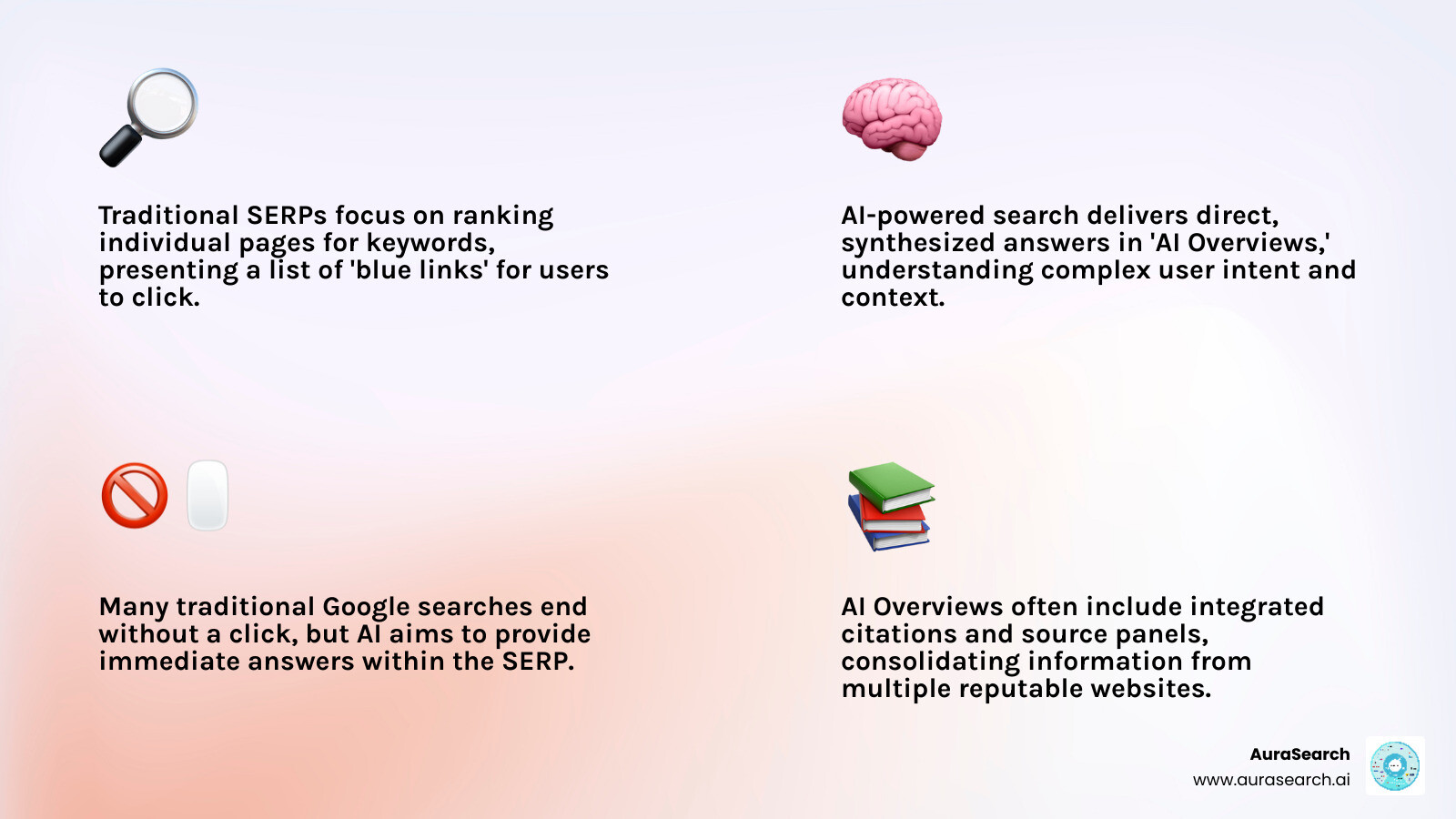
The shift is dramatic. Traditional SEO focused on ranking pages for keywords, but AI search prioritizes content that answers questions directly . It synthesizes information from multiple sources, meaning your content must be structured for AI systems to extract, understand, and cite your information. The companies adapting to this reality are seeing significant gains - some reporting 67% increases in referral traffic from AI platforms like Perplexity.
If you're experiencing declining organic traffic despite maintaining good traditional rankings, or struggling to appear in AI Overviews and featured snippets, you're not alone. The solution lies in understanding how AI processes and prioritizes content.
The New Paradigm: From Keywords to Conversations
Think about how you search today versus five years ago. Instead of typing "best pizza NYC," you're now asking "where can I find authentic Neapolitan pizza in Manhattan that's open late?" This shift from choppy keywords to natural conversation is exactly what's driving the revolution in how to optimize content for AI search .
AI is fundamentally changing how search engines work by moving beyond simple keyword matching to actually understanding what people really want. Modern AI systems use natural language processing (NLP) to grasp the intent behind your questions, not just the words you type. When someone asks "How do I fix a leaky faucet?", AI doesn't just look for pages containing those exact words - it understands they need step-by-step repair instructions.
This change has given birth to what we call Generative Engine Optimization (GEO) - the art of creating content that AI systems love to reference and cite. Unlike traditional SEO that focused on ranking individual pages, GEO is about becoming the go-to source when AI generates answers.
The user behavior shift is remarkable. We've moved from searching to asking , from browsing multiple pages to expecting immediate answers , and from gathering scattered information to receiving synthesized knowledge . AI-powered platforms now provide direct answers by pulling information from multiple sources and presenting it as a cohesive response.
For content creators, this means writing for two audiences: humans who want engaging, valuable information, and AI systems that need clear, structured, and factually accurate content they can easily understand and cite. The sweet spot is content that reads naturally to humans while being perfectly digestible for AI.
Understanding E-E-A-T in the AI Era
AI systems are adept at identifying fake expertise. They analyze author credentials, cross-reference claims, and check for brand mentions on other credible sites. Experience, Expertise, Authoritativeness, and Trustworthiness (E-E-A-T) is no longer just a ranking factor—it’s how AI decides whether to trust and cite your content.
Building genuine expertise means going beyond surface-level content. Share real case studies, include specific data points, and don't be afraid to get technical when it adds value. AI systems can tell the difference between rehashed information and genuine insights from experience.
Demonstrating authoritativeness requires consistent presence across the web. This means earning mentions in industry publications, getting cited by other experts, and building a reputation that extends beyond your own website. AI systems look for these third-party validation signals when determining credibility.
Establishing trustworthiness is about transparency and accuracy. Always cite your sources, keep information current, and include detailed author bios that showcase relevant credentials. When AI systems fact-check your content against other sources, you want to be the one they consistently validate, not contradict.
Focusing on E-E-A-T creates a positive feedback loop: as AI systems trust and cite your content, you build more authority, leading to even more AI citations and visibility.
Structuring Content for Featured Snippets and AI Summaries
Featured snippets have become the golden ticket of search results, and here's why you should care: content that appears in featured snippets sees a 42% increase in click-through rates . More importantly, these snippets often become the foundation for AI-generated answers across multiple platforms.
The secret to snippet success lies in the inverted pyramid approach . Lead with your most important answer, then expand with supporting details. When someone asks "What is schema markup?", your first sentence should be a clear, complete definition that could stand alone as an answer.
Structure is everything when it comes to AI extraction. Use descriptive headings that mirror how people actually ask questions. Instead of "Implementation Methods," try "How Do You Implement Schema Markup?" This approach helps both users scanning your content and AI systems understanding what information follows.
Tables work exceptionally well for comparative information because they provide clear, structured data that AI can easily parse and present. Whether you're comparing features, prices, or specifications, tables make your information snippet-ready.
The magic happens when you combine clear formatting with comprehensive coverage. Use bullet points for processes, numbered lists for sequential steps, and short paragraphs for explanations . This creates multiple opportunities for AI systems to extract and cite different parts of your content depending on the specific query.
You're not just optimizing for one snippet; you're creating content that AI can reference for dozens of related queries. Thoughtful structure makes your content a more reliable source for comprehensive AI answers.
Crafting AI-Ready Content: A Practical Guide

Creating content that AI search engines love isn't rocket science, but it does require a shift in how we think about writing. How to optimize content for AI search comes down to one key principle: write for humans first, then structure it so machines can easily understand and cite your work.
AI models have a clear preference for content that's clean, readable, and genuinely helpful . They're not impressed by fancy jargon or overly complex explanations. Instead, they reward simplicity and clarity above all else.
Here's something interesting: the average word count for articles cited in general queries hovers around 1,500 words , while YMYL (Your Money Your Life) topics tend to get cited at around 1,000 words . This tells us that comprehensive coverage matters, but so does staying focused and not rambling.
Content freshness is another game-changer. AI systems are constantly hungry for new, updated information. If you have older content that's still valuable, don't let it gather digital dust. Regular updates signal to algorithms that your content remains relevant and trustworthy.
The beauty of AI-ready content is that it's also incredibly user-friendly . When you write with clear headings, short paragraphs, and logical flow, you're creating content that both humans and AI can steer effortlessly.
How to optimize content for AI search with conversational language
The days of stuffing keywords into robotic sentences are long gone. AI search is fundamentally conversational , and your content needs to reflect how real people actually speak and ask questions.
Think about it: when someone uses voice search, they don't say "best pizza restaurant." They ask, "What's the best pizza place near me that's open right now?" This shift toward natural language patterns is reshaping how we need to create content.
Long-tail keywords have become your best friends in this new landscape. These conversational phrases mirror how people naturally speak to their devices. Tools like AnswerThePublic can help you find the exact questions your audience is asking, giving you a roadmap for content that truly resonates.
Question-based queries should be woven throughout your content like threads in a mix. Don't just answer the main question – anticipate the follow-ups. If you're explaining how to fix a leaky faucet, also address why faucets leak and what tools are needed. The more questions you answer naturally within your content, the more likely AI will choose you as a source.
Writing in a genuinely conversational tone makes your content more accessible to AI systems, which are designed to understand and respond to human language patterns. This natural approach is key.
The Importance of Factual Accuracy and Citations
In AI search, your credibility is everything. AI systems have become incredibly sophisticated at identifying trustworthy sources, and they're not easily fooled by flashy content that lacks substance.
Citing authoritative sources isn't just good practice – it's essential for AI visibility. Every claim you make should be backed by credible evidence. Link to reputable studies, academic papers, and official government or educational websites. AI algorithms have a clear preference for trusted domains, especially those ending in .gov or .edu.
Data-driven content performs exceptionally well in AI search results. Statistics, research findings, and unique visual elements like charts or diagrams catch AI attention. Interestingly, AI platforms show different preferences for visual content depending on the topic – while general queries might include images 70% of the time, YMYL topics are more conservative, including visuals only about 10% of the time.
This difference highlights how seriously AI systems take YMYL considerations . When it comes to health, finance, or safety topics, factual accuracy becomes even more critical. AI platforms like Perplexity provide source links 100% of the time for informational queries, demonstrating their commitment to transparency and accuracy.
AI search rewards verifiably accurate content. Building a foundation of trust through citations and fact-checking positions your content as a reliable source for AI systems.
Technical SEO: How to Optimize Content for AI Search Crawlers

The technical foundation of how to optimize content for AI search looks familiar on the surface, but AI crawlers bring their own quirks and challenges. Think of them as impatient visitors who want everything served quickly and clearly - no fancy tricks, just straight answers.
Here's what makes AI crawlers different: they're working with tight timeouts of just 1-5 seconds, and they're surprisingly inefficient compared to traditional crawlers. In fact, AI crawlers show 47 times more inefficiency than their traditional counterparts and represent about 28% of Googlebot's volume . Even more concerning, 34% of AI crawler requests result in 404 errors or other problems .
Website structure and clean HTML
become even more critical when dealing with these picky visitors. AI crawlers thrive on well-organized content with proper heading structures (H1-H6) and semantic HTML elements like <article>
, <section>
, and <nav>
. These elements act like road signs, helping AI understand exactly what each part of your content does.
Page speed is make-or-break. Aim for content to load in under one second. Slow loading times cause AI crawlers to truncate or completely skip your content, making it invisible to them.
Mobile optimization remains crucial since AI algorithms heavily favor content that works seamlessly across all devices. Your responsive design needs to be flawless because AI systems are checking.
But here's the big technical gotcha: JavaScript rendering issues . Most AI crawlers struggle with JavaScript, and currently only Google's Gemini and AppleBot can render it properly among major AI crawlers. If your key content relies on client-side JavaScript, it might be completely invisible to most AI systems. This means prioritizing server-side rendering or plain HTML for your most important information.
Leveraging Structured Data for AI Comprehension
Think of structured data as giving AI crawlers a detailed map of your content. Schema markup using JSON-LD is like providing a cheat sheet that explains exactly what your content contains and how it's organized.
FAQPage Schema has become essential for any content built around questions and answers. It dramatically increases your chances of appearing in AI Overviews and featured snippets. HowTo Schema works beautifully for step-by-step guides, making it easy for AI to extract and present your instructions clearly.
For businesses selling products, Product Schema helps AI understand details like pricing, reviews, and specifications. Article Schema clearly defines headlines, authors, and publication dates for blog posts and news content.
Implementing structured data from the official Schema.org documentation helps AI systems process your information efficiently. It allows them to categorize and present your content accurately in AI-generated answers, rather than guessing its meaning.
Managing AI Crawlers and Training Data
A key challenge is allowing AI search engines to cite your content while preventing it from being used to train future AI models without permission. You need to strike a delicate balance.
Your robots.txt file becomes the gatekeeper for this. You can configure it to welcome AI crawlers that help with search results while politely declining those focused on data collection for training. For example, you might allow Google-Extended (used for AI Overviews) but block GPTBot or CCBot (often used for training).
The emerging llms.txt file standard works similarly to robots.txt but specifically tells Large Language Models how they can use your content. It's a proactive way to set boundaries while still participating in the AI ecosystem.
Key AI crawlers you should know about include OpenAI's GPTBot and ChatGPT-User , Google's Google-Extended and GoogleOther , Anthropic's ClaudeBot , Perplexity's PerplexityBot , and Common Crawl's CCBot . A comprehensive list of AI crawlers helps you stay current as new ones emerge.
The sweet spot is configuring fairly open access for search-related AI agents while selectively blocking general training crawlers. Avoid being overly aggressive with bot protection - you don't want to make your content invisible to all AI systems when you're trying to optimize for their search capabilities.
Measuring Success and Adapting to the Future

The metrics that mattered yesterday might not tell the whole story today. How to optimize content for AI search isn't just about creating the right content—it's about measuring what actually works in this new landscape.
Traditional SEO metrics like rankings and organic traffic are still valuable, but they're only part of the picture now. We need to dig deeper into AI-centric metrics that reveal how our content performs when AI systems are doing the heavy lifting.
Snippet performance is crucial. Appearing in featured snippets or AI Overviews is a primary goal. Google Search Console can help you track this visibility, showing how often your content earns these premium placements.
But visibility is just the beginning. User engagement tells us what happens after people find our content through AI sources. Are they sticking around? Are they diving deeper into our site? Dwell time, bounce rate, and content consumption patterns from AI referral traffic often look different from traditional search traffic—and that's valuable intelligence.
Voice search traffic deserves special attention, especially if you've optimized content for conversational queries. Google Search Console can help you identify which voice-enabled devices are sending you traffic, giving you insights into how people are actually talking to their devices about your topics.
Here's where it gets really interesting: Share of Voice in AI-generated answers. This means tracking how often your brand or content gets cited compared to others in your space. Some businesses are seeing significant increases in engaged traffic from platforms like Perplexity and other AI-powered search tools.
Regular content audits aren't optional anymore—they're essential. The AI landscape shifts quickly, and what worked last month might need tweaking today. Continuous experimentation helps you stay ahead of these changes rather than constantly playing catch-up.
The First-Mover Advantage: Benford's Law and AI Search
Being first in AI search isn't just nice to have—it's everything. There's actually some fascinating math behind this, called Benford's Law , which shows how first positions get referenced way more than you'd expect.
Think about it: when an AI system synthesizes information, it often pulls from just a few top sources. If your content isn't in that elite group, it might as well be invisible. This disproportionate referencing of top-ranking content means that ranking first gives you an outsized advantage.
This becomes even more critical with voice search dominance . When someone asks their smart speaker a question, they typically get one answer. Just one. That's your entire Share of Voice right there—either you're the answer, or you're not.
The companies that understand this are already positioning themselves to capture these first-mover advantages. They're not just optimizing for search; they're optimizing to be the definitive source that AI systems turn to first.
How to optimize content for AI search using AI tools
Ironically, the best way to optimize for AI search is often to use AI tools yourself. This helps you stay competitive and improve your workflow.
Content generation tools can be incredible brainstorming partners. They help you generate content ideas, draft sections, and create outlines that are naturally structured for search engines. But remember—they're assistants, not replacements. Your human expertise and unique insights are what make the content truly valuable.
SEO analysis tools powered by AI can spot patterns and opportunities that would take hours to find manually. They analyze your content against AI-driven ranking factors and provide actionable recommendations that actually make sense.
AI for data analysis is where things get really powerful. The amount of data generated by AI search platforms can be overwhelming. AI tools can process this information quickly, identifying trends and insights that inform your strategy moving forward.
The key is staying competitive while maintaining authenticity. AI tools should improve your workflow and help you make data-backed decisions , not replace the human creativity and expertise that makes content worth reading in the first place.
At AuraSearch, we've built our entire approach around helping businesses steer this new landscape. Our AI SEO services combine the efficiency of AI tools with human expertise to help you adapt and win in this evolving search environment.
Frequently Asked Questions about Optimizing for AI Search
Let's tackle the most common questions we hear about making the transition from traditional SEO to AI-optimized content. These answers will help clarify the fundamental shifts happening in search and how to optimize content for AI search effectively.
What are the fundamental differences between traditional SEO and AI search optimization?
Traditional SEO focused on ranking individual pages for specific keywords using signals like keyword density and backlinks. AI search optimization is fundamentally different.
Instead of matching keywords, AI systems focus on semantic understanding and user intent . They're looking for content that provides direct, synthesized answers that can be pulled from multiple sources and combined into comprehensive responses.
Where traditional SEO might optimize for "best coffee makers," AI search optimization targets the underlying questions: "What makes a good coffee maker?" or "Which coffee maker should I buy for a small kitchen?" The content needs to be structured for easy extraction and demonstrate strong E-E-A-T signals - expertise, experience, authoritativeness, and trustworthiness.
The biggest shift? AI prioritizes conversational and contextually relevant content that can be easily cited and referenced, rather than pages that simply rank well for isolated keywords.
How can I allow AI crawlers for search but block them from using my content for model training?
This requires technical finesse, but you have control via your robots.txt file . You can set different rules for different AI crawlers to manage access.
Here's the strategy: Allow crawlers that help with search visibility
while blocking those focused on training future models. For example, you might allow Google-Extended
(which powers AI Overviews and search results) while using a Disallow
directive for crawlers like GPTBot
or CCBot
that primarily collect training data.
The key is to understand that not all AI crawlers serve the same purpose. Some are beneficial for search visibility, while others collect data to train AI models, which you may want to restrict.
There's also an emerging standard called llms.txt that will offer even more granular control over how AI systems interact with your content. Think of it as a more sophisticated version of robots.txt specifically designed for the AI era.
What are the most important metrics to track for AI search success?
Measuring success in AI search requires looking beyond traditional page rankings and click-through rates. The metrics that matter most reflect how well your content performs in AI-generated responses and conversations.
Visibility in AI Overviews and featured snippets is your primary indicator of success. These placements often translate directly into increased traffic and brand recognition. Track how frequently your content appears in these premium positions using Google Search Console.
Referral traffic from AI platforms like Perplexity, ChatGPT, and Google's AI features tells you whether people are actually finding and engaging with your content through AI channels. Some businesses are seeing significant increases in highly engaged traffic from these sources.
Perhaps most importantly, monitor your "Share of Voice" within AI-generated answers . This means tracking how often your brand or content gets cited compared to competitors when AI systems provide responses in your industry.
Don't forget about user engagement signals for AI-sourced traffic. Metrics like dwell time and bounce rate for visitors coming from AI platforms indicate whether your content truly satisfies user intent - something AI systems increasingly factor into their recommendations.
Since the landscape evolves quickly, regularly monitoring and adjusting based on these metrics is essential for staying competitive.
Conclusion
The shift to Generative Engine Optimization (GEO) isn't just another marketing buzzword – it's a complete change of how we think about reaching our audience. Understanding how to optimize content for AI search has become as essential as having a website itself.
We're living through a pivotal moment. The old playbook of stuffing keywords and building links is giving way to something far more sophisticated and, frankly, more human. AI systems want the same thing your readers want: clear, helpful, trustworthy content that actually answers their questions.
The fundamentals we've covered aren't going anywhere. Building genuine expertise and authority, structuring content for easy understanding, writing conversationally, and maintaining technical excellence – these principles will only become more important as AI systems get smarter at detecting quality.
This transition is an opportunity: the best practices for AI search also make your content better for humans. When you write clearly, cite sources, and answer questions directly, your readers, AI systems, and your business all benefit.
The companies thriving in this new landscape aren't necessarily the biggest or most established. They're the ones adapting quickly, experimenting with AI-friendly content structures, and building real authority in their fields. There's still time to get ahead of the curve, but the window won't stay open forever.
At AuraSearch, we've seen how businesses transform their online presence when they accept these changes rather than fight them. The future belongs to content creators who understand that AI search isn't replacing human connection – it's amplifying it.
Ready to find what this new era of search can do for your business? Find how to win in the new era of search and let's build something remarkable together.