Introduction: The Search Tsunami Hits Australian Shores
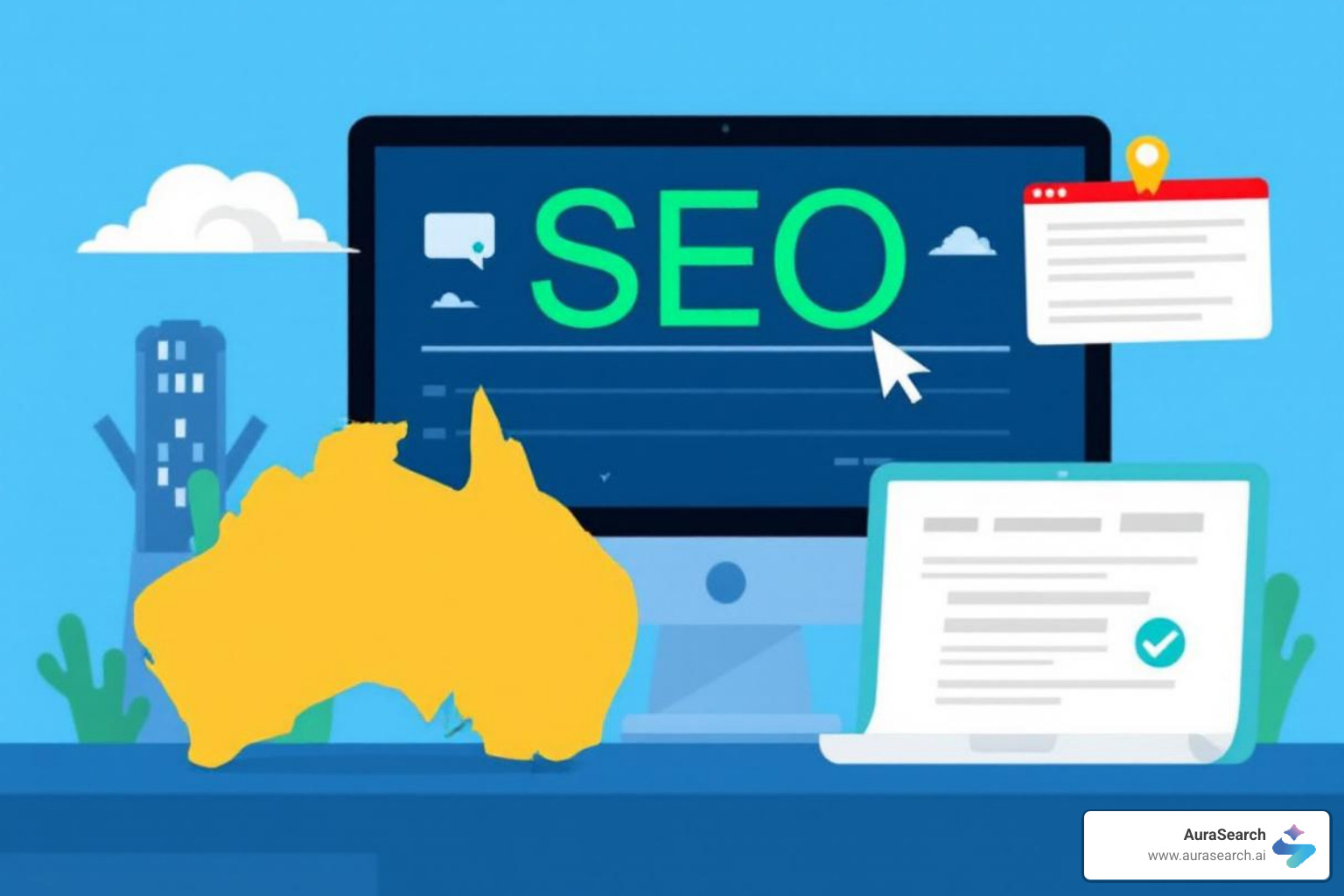
ChatGPT SEO Australia is fundamentally changing how businesses get finded online. If you've noticed your organic traffic declining despite maintaining good rankings, you're not alone—AI platforms like ChatGPT are reshaping search behavior across the country.
Key Changes for Australian Businesses:
- From Rankings to Citations : Traditional #1 Google rankings matter less when AI platforms cite multiple sources in conversational answers
- Conversational Queries Replace Keywords : Users now ask full questions like "What's the best accounting software for Australian small businesses?" instead of typing "accounting software Australia"
- Zero-Click Results Dominate : AI Overviews and ChatGPT answers mean users get information without clicking through to websites
- Trust Signals Trump Technical SEO : E-E-A-T (Experience, Expertise, Authoritativeness, Trustworthiness) determines whether AI platforms cite your content
Australia ranks as the most AI-addicted country in the world with 1.42 searches per person using AI tools. This isn't a future trend—it's happening right now. ChatGPT has over 800 million active users weekly, and 22% of Australians already use it regularly.
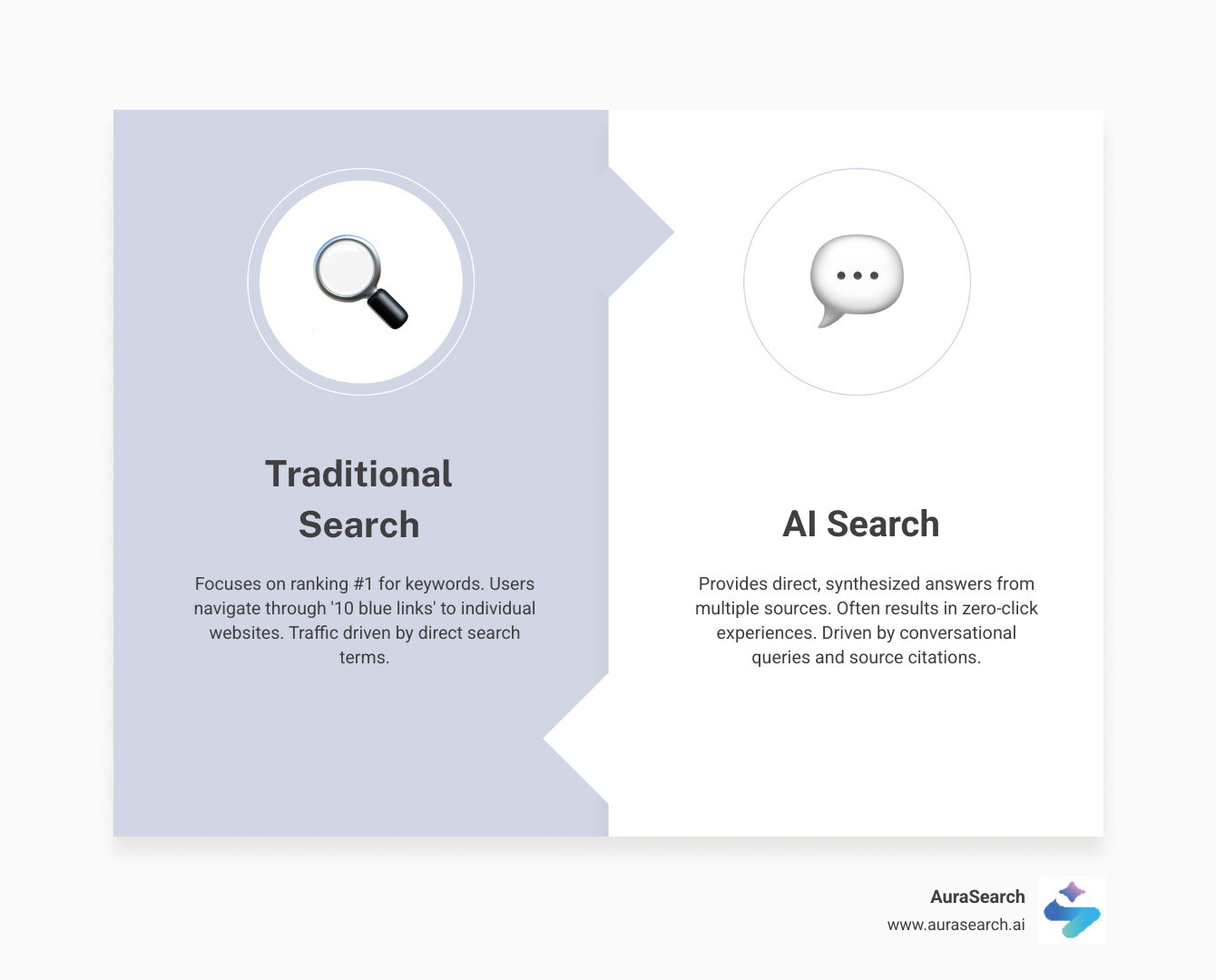
The shift is stark. Google's "10 blue links" gave businesses clear targets to optimize for. AI search provides direct answers drawn from multiple sources, fundamentally changing how users find brands and products.
Traditional search meant ranking first for "best running shoes Australia" drove predictable traffic. AI search means ChatGPT might synthesize information from five different sources to answer "recommend running shoes for my Brisbane marathon training"—and your site might not get a click even if you're cited.
The good news? This creates massive opportunities for businesses that adapt early. The bad news? Traditional SEO tactics alone won't cut it anymore.
Key terms for chatgpt seo australia :
The Great Search Shift: How AI is Rewriting the Rules of SEO
The internet is undergoing a seismic shift, one that’s fundamentally altering how users find information and how businesses get finded. We're moving from a world where we painstakingly crafted keyword-rich content to rank for "10 blue links" to one dominated by AI agents. These intelligent assistants are adept at sifting through vast amounts of data, synthesizing answers, and even making recommendations, often without a user ever needing to click through to a website. This isn’t just an evolution; it’s a revolution.

Traditional SEO focused on optimizing for search engine algorithms that prioritized keywords, backlinks, and technical site health to deliver a list of ranked results. Today, AI-driven search, exemplified by ChatGPT and Google's AI Overviews, functions more like a knowledgeable friend. Users engage in conversational queries, asking complex, multi-part questions that traditional keyword searches simply couldn't handle. These AI systems then aim to provide direct answers, often leading to "zero-click searches" where the user's query is resolved right on the search results page or within the AI interface.
This fundamental shift from “10 blue links” to conversational answers means our SEO strategies must evolve from simply ranking to being cited and trusted. AI models are trained to understand user intent with unprecedented depth, and our content needs to reflect this by providing comprehensive, context-rich, and authoritative information.
What is ChatGPT SEO and how does it differ from traditional SEO?
ChatGPT SEO, or Generative Engine Optimisation (GEO), is a specialized approach to ensuring our digital content is findable, understandable, and trustworthy for AI-driven search engines and conversational platforms. It’s about optimizing for visibility within these large language models (LLMs), not just for traditional search engine results pages (SERPs).
The core difference lies in the objective: traditional SEO aims for a high ranking in a list of results, while ChatGPT SEO aims to be the cited source within an AI-generated answer. This means:
- Context over Keywords : While keywords still play a role, AI responses prioritize context and semantic relevance. As recent studies show, AI responses are triggered by informational search intent keywords 99.2% of the time, but within the results to a user’s query, the exact keyword is only mentioned 5.4% of the time. This tells us AI focuses on understanding the intent behind the query and drawing from content that comprehensively addresses that intent, rather than simply matching keywords.
- Citation vs. Ranking : Being cited by ChatGPT or featured in an AI Overview means your content is deemed authoritative enough to directly answer a user's question. This is a powerful trust signal, akin to a personal recommendation.
- Trust Signals are Paramount : AI systems are designed to provide accurate and reliable information. Therefore, our content must demonstrate strong trust signals, which we'll dig into shortly.
Traditional SEO helps users find our website; ChatGPT SEO helps AI understand and recommend our website.
The Rise of the AI Shopper: Agentic Shopping in Australia
Imagine a customer asking an AI assistant, "What's the best sunscreen for sensitive skin in Australia that's reef-safe and ships quickly to Perth?" This isn't a simple keyword search; it's an "agentic shopping" query. Agentic shopping refers to the growing trend where AI tools act as personal shopping assistants, performing complex research, comparing products, and making personalized recommendations based on detailed user criteria.
This trend is particularly crucial for Australian retailers, especially those with Shopify stores. Why is optimizing Shopify stores for ChatGPT and AI search so vital? Because these AI agents are increasingly bypassing traditional shopping funnels. Instead of searching on Google, clicking through to a website, and then browsing, users are getting product recommendations directly from AI.
Consider these statistics:
- Close to 60% of US consumers started their online shopping searches on Amazon as of Q2 2023 , which is more than those who started on a search engine (42%). This highlights a shift away from traditional search engines for product findy.
- Google's own senior vice president, Prabhakar Raghavan, stated that almost 40 percent of young people, when they’re looking for a place for lunch, they don’t go to Google Maps or Search. They go to TikTok or Instagram.
- A 2024 study from Adobe found that over 2 in 5 Americans use TikTok as a search engine, with nearly 1 in 10 Gen Zers more likely to rely on TikTok than Google as a search engine.
These trends, while US-centric, reflect a global shift in consumer behavior that is rapidly gaining traction in tech-savvy Australia. For Shopify retailers, this means that merely having a great product isn't enough; our product information needs to be structured, unique, and authoritative enough for AI systems to recommend it. Duplicated product descriptions from supplier feeds, a common issue for many Shopify stores, will simply get lost in the noise. AI platforms prioritize clarity, structure, and brand authority. Therefore, optimizing our Shopify stores for AI search isn't just an advantage; it's a necessity for future growth and visibility.
The New Playbook: Core Strategies for ChatGPT SEO in Australia
The shift to AI-driven search demands a new playbook for Australian businesses. Our focus must move towards a proactive approach that builds deep brand authority, leverages intelligent content strategies, and accepts technical optimisation custom for machine readability. This isn't about quick hacks; it's about fundamentally rethinking how our digital presence interacts with the evolving search landscape.

Mastering E-E-A-T: Becoming a Trusted Source for AI
E-E-A-T (Experience, Expertise, Authoritativeness, Trustworthiness) has always been important for Google, but in the age of AI, it's the bedrock of our ChatGPT SEO Australia strategy. AI systems, designed to provide reliable information, heavily scrutinize these signals when deciding which content to trust and cite. AI search likely uses these signals heavily to filter out misinformation and low-quality content.
Here’s how each element influences AI search visibility for Australian businesses:
- Experience : Does our content demonstrate first-hand experience? For example, if we're selling camping gear, do we have blog posts written by experienced Australian campers sharing their real-world insights, complete with photos and stories from the Aussie bush?
- Expertise : Is the content created by individuals with demonstrable knowledge in the field? We should showcase authors with clear qualifications, industry certifications, or relevant professional backgrounds. For a health product, this might mean content reviewed by a registered Australian dietitian.
- Authoritativeness : Is our website recognized as a go-to source within its niche? This comes from being cited by other reputable sources, receiving industry awards, or having a strong digital PR presence. Think about local industry bodies, news outlets, or academic institutions in Australia linking to our content.
- Trustworthiness : Is our website safe, transparent, and reliable? This includes having clear privacy policies, secure connections (HTTPS), accurate contact information, and, crucially, positive customer reviews on platforms like TrustPilot , Yelp , and Google. These signals help ChatGPT identify our brand as credible.
To build E-E-A-T, we need to:
- Develop detailed author bios with credentials for every content creator.
- Publish case studies and testimonials that highlight our expertise and trustworthiness.
- Actively encourage satisfied customers to leave positive reviews.
- Seek out opportunities for digital PR and collaborations with authoritative Australian sites.
Structuring for Success: The Critical Role of Schema and Data
For AI to understand our content, it needs to be presented in a machine-readable format. This is where structured data and schema markup become indispensable for ChatGPT SEO Australia . Schema markup is a semantic vocabulary that we can add to our HTML to help search engines (and now AI systems) better understand the meaning and context of our content.
Proper schema implementation creates machine-readable context that helps AI systems correctly interpret and potentially feature our content. Think of it as giving AI a clear, organized map of our website's information.
Key schema types for Australian businesses include:
- Product Schema : Essential for e-commerce, especially Shopify stores. This markup provides AI with details like price, availability, reviews, and product identifiers, making our products easier for agentic shopping AI to recommend.
- FAQ Schema : Ideal for Q&A content, helping AI understand specific questions and their answers directly. This is crucial for answering conversational queries.
- Article Schema : For blog posts and informational content, providing details like author, publication date, and topic, boosting our content's E-E-A-T signals.
- Local Business Schema : Vital for Australian businesses with physical locations, helping AI understand our services, opening hours, and geographic relevance for local queries.
Beyond schema, we should also consider technical signals like llms.txt
. Similar to robots.txt
, this file can signal to large language models how they should interact with our site's content, ensuring our valuable information is accessible and correctly interpreted by AI. For more insights into how to structure your site for AI, explore our AI SEO services.
What are the best practices for content in chatgpt seo australia?
Content is king, but in the AI era, it needs to be a very specific kind of king: knowledgeable, conversational, and carefully structured. Here are our best practices for creating content that thrives in ChatGPT SEO Australia :
- Accept a Conversational Tone : AI search queries are naturally conversational. Our content should anticipate and directly answer specific questions users are likely to ask. This means writing in a clear, natural language that mirrors how people speak, rather than keyword-stuffed prose.
- Prioritize Comprehensive, Factual Content : AI systems favor greater emphasis on comprehensive, factual content over marketing materials. Our content should be in-depth, well-researched, and provide complete answers to user queries, establishing our site as an authoritative resource.
- Unique Content is Non-Negotiable : Google has long penalized duplicated content, a practice that now also blindsides AI Search Engines. If we're using generic product descriptions from suppliers, AI will likely ignore our content. We must invest in creating unique, original descriptions and informational content that stands out. This is especially true for Australian e-commerce, where differentiating our Shopify store from competitors is paramount.
- Maintain a Distinct Brand Voice : While AI can generate text, a unique brand voice and tone are crucial for connecting with Australian audiences and building a memorable brand. This human touch helps our content resonate and strengthens our E-E-A-T.
- Structure for Clarity and AI Comprehension : Use clear headings (H1, H2, H3), bullet points, numbered lists, and tables. This makes content skimmable for humans and easily digestible for AI, helping it extract key information for summaries.
- Leverage Visual Content and Other Media : AI systems are increasingly incorporating image, voice, and video inputs alongside text. This means we should optimize our visual assets with descriptive alt text, create engaging video content, and ensure accessibility across all media types. ChatGPT pulls visual content from platforms like YouTube and Pinterest, so optimizing our presence on these platforms is also key.
- Advanced Keyword Research and Content Optimization with ChatGPT : We can leverage ChatGPT as a powerful assistant for advanced keyword research and content optimization. We can ask it to "Generate a list of long-tail SEO keywords related to organic gardening solutions" or to suggest improvements for meta descriptions and content organization. While it's an excellent tool for quickly sorting through large amounts of data and streamlining content creation, we must always verify its output and add our unique human expertise and Australian context.
Beyond the Bot: Optimising for Bing and Google's AI Overviews
The AI search landscape is not monolithic. While ChatGPT is a prominent player, we also need to consider its underlying search mechanisms and the impact of Google's own AI features. The search ecosystem is becoming increasingly fragmented, with different AI platforms having distinct indexing and citation behaviors.
Why Optimising for Bing is Your Secret Weapon
This might sound counter-intuitive, especially for those accustomed to Google's dominance, but optimizing for Bing is now a surprisingly effective strategy for ChatGPT SEO Australia . Here's why:
A significant trend across AI search platforms is the shift from Google’s proprietary index to Microsoft Bing as the underlying search provider for many major AI platforms. OpenAI’s ChatGPT, Perplexity, and Claude now all rely on Microsoft Bing as their primary search engine. Microsoft's investment in OpenAI is a key factor here; Microsoft announced Bing will have ChatGPT-powered features early on, integrating the AI directly into its search experience.
This has profound implications for Australian businesses: optimising for Bing’s algorithms is now the most important way to indirectly improve visibility across multiple AI search platforms. If our content isn't optimized for Bing, it might be essentially invisible to these AI systems, regardless of our Google rankings.
Our strategy should include:
- Bing Webmaster Tools : Just like Google Search Console, this platform helps us monitor our site's performance on Bing, identify crawling issues, and submit sitemaps.
- Bing Places for Business : Optimizing our local listings on Bing is crucial for local AI queries, ensuring our business appears in recommendations for local services or products.
- Bing's Ranking Signals : While similar to Google, Bing has its own nuances. We should ensure our content is high-quality, trustworthy, and well-structured, aligning with Bing's preferences.
By focusing on Bing, we gain an indirect yet powerful advantage in the broader AI search ecosystem.
Navigating Google AI Overviews and Their Impact on Australian Traffic
Google, not to be outdone, has rolled out its own AI-powered features, most notably AI Overviews (AIOs), which deliver AI-generated summaries directly at the top of search results. These AIOs are already impacting Australian SEO strategies and referral traffic.
The primary impact is a shift from traditional rankings to citation opportunities . While our goal used to be the top organic spot, now it's about being cited within the AI Overview. The challenge? AIOs often provide enough information for users to resolve their query without clicking through to any website. Analysis of 300,000 keywords found that “the presence of an AI Overview in search results correlated with a 34.5% lower average clickthrough rate for the top-ranking page”. This means even if we're featured, our referral traffic might decrease.
To adapt to this, Australian businesses need to:
- Focus on High-Intent Commercial Queries : While informational queries are most likely to trigger AI responses, we should prioritize optimizing for commercial, transactional keywords where users are closer to making a purchase. Even if an AIO appears, the user might still click through for more detailed product information or to complete a transaction.
- Own Branded Search : When users search for our brand directly, AI Overviews are more likely to feature our official content. This is a fast way to leverage AI features and control the narrative around our brand.
- Rethink Traditional SEO : The rise of AI-driven search demands a complete rethinking of SEO strategy. SEO keywords are rapidly becoming secondary to demonstrating genuine expertise. Australian SEO specialists are adapting by focusing on conversational content, user intent, E-E-A-T, and structured data, rather than just keyword density. We're moving towards a multi-platform approach, understanding that search extends beyond Google. Recent studies show that organisations with high SEO maturity are more than three times more likely to report a positive impact from AI compared to those with low SEO maturity. This highlights the urgency for Australian businesses to accept AI-driven SEO.
Frequently Asked Questions about ChatGPT SEO in Australia
How can Australian businesses measure the ROI of ChatGPT SEO?
Measuring the ROI of ChatGPT SEO Australia requires a shift in perspective from traditional metrics. Since AI often provides direct answers, traditional click-through rates might not tell the whole story. Here’s how we can measure success:
- Monitoring Brand Mentions and Citations : We need tools that can track when our brand or content is cited within AI-generated responses (e.g., ChatGPT answers, Google AI Overviews). This indicates our content is deemed authoritative by AI.
- Tracking Referral Traffic from AI Sources : While direct attribution can be challenging, monitoring traffic sources for new "AI" or "chatbot" referrals, or even specific long-tail, conversational queries that AI might have answered, can provide insights.
- Shift in Keyword Performance : Instead of just looking at rankings, we analyze the types of queries our content is appearing for in AI responses. Are they high-intent questions? Are they leading to more qualified leads, even if direct clicks are lower?
- Lead Quality from Organic Search : If users are getting more refined answers from AI, the traffic that does click through to our site might be more qualified and further down the conversion funnel. We look for improvements in conversion rates from organic traffic.
- New KPIs : We introduce new metrics like "AI Visibility Score" (how often our brand is mentioned by AI) and monitor engagement signals that indicate our content is resonating, even in a zero-click environment. We also educate clients on non-traffic metrics for SEO success in this new paradigm.
How does the rise of AI impact local SEO for Australian businesses?
The impact of AI on local SEO for Australian businesses is significant, changing how local recommendations are made. AI tools act as local guides, and our businesses need to be prominently featured in their advice:
- Improved Local Pack Visibility : AI systems will heavily rely on local business profiles to provide recommendations. Ensuring our Google Business Profile and Bing Places for Business listings are fully optimized, accurate, and up-to-date is more critical than ever.
- AI Using Local Listings for Recommendations : When a user asks, "Where's the best cafe in Surry Hills for brunch?", AI will pull information from these local listings, reviews, and website content to make its recommendations.
- Customer Reviews as Trust Signals : Positive customer reviews are paramount. AI considers these reviews as strong trust signals, influencing its recommendations for local businesses.
- Location-Based Conversational Queries : Users are increasingly asking specific, location-based conversational queries. Optimizing our content to answer these directly—e.g., "best electrician in Melbourne for emergency repairs"—will boost our chances of being recommended by AI. almost 40 percent of young people, when they’re looking for a place for lunch, they don’t go to Google Maps or Search. They go to TikTok or Instagram. This behavior will extend to AI, making local presence crucial across multiple platforms.
What are the common pitfalls to avoid when implementing chatgpt seo australia strategies?
While the opportunities are vast, there are common missteps we must avoid when implementing ChatGPT SEO Australia strategies:
- Over-reliance on AI-generated content without human oversight : While AI is a powerful tool, blindly publishing AI-generated content without human fact-checking, editing, and adding a unique brand voice can lead to inaccuracies, generic content, and a lack of E-E-A-T. Always verify the accuracy of the information provided by ChatGPT.
- Ignoring SEO fundamentals : AI SEO builds upon, rather than replaces, traditional SEO. Neglecting technical SEO, site speed, mobile-friendliness, or basic keyword research will hinder AI's ability to crawl and understand our content.
- Neglecting E-E-A-T signals : If our content lacks demonstrable experience, expertise, authoritativeness, and trustworthiness, AI systems will bypass it for more credible sources. This is a critical foundation for AI visibility.
- Chasing algorithms instead of user intent : The goal is not to trick the AI, but to provide the best, most comprehensive answer to a user's query. Focusing solely on technical tweaks without genuinely serving user intent will be a short-lived strategy.
- Failing to monitor results and adapt : The AI landscape is rapidly evolving. What works today might not work tomorrow. We must continuously monitor our AI visibility, track new trends, and adapt our strategies accordingly.
- Using duplicated content : As mentioned, Google has long penalized duplicated content, a practice that now also blindsides AI Search Engines. This is a critical pitfall for Australian e-commerce stores using generic supplier descriptions.
Conclusion: Your Future in Search Starts Now
The future of search is conversational, comprehensive, and increasingly driven by artificial intelligence. For Australian businesses, this isn't a distant threat but a present opportunity to redefine our digital presence. The shift from traditional "10 blue links" to direct, AI-generated answers means that a proactive approach to ChatGPT SEO Australia is no longer optional—it's essential for survival and growth.
The benefits of adapting early are clear: a first-mover advantage in new findy channels, building unparalleled brand authority, and future-proofing our business against an changing digital landscape. Emerging trends like multimodal integration (incorporating image, voice, and video inputs), improved personalization of AI responses, and the rise of more sophisticated AI agents that conduct deep research on behalf of users will only accelerate this change. Furthermore, with the Australian government developing a national AI ethics framework , responsible AI adoption will be key. Projections state that ChatGPT's user base will reach 1 billion in 2025 , highlighting the scale of this shift.
The opportunity for Australian brands is to become the trusted, cited source in these AI conversations. This requires a strategic blend of human expertise and AI-powered tools to create unique, authoritative, and perfectly structured content. At AuraSearch, we understand these complexities. Our expert generative AI SEO services are designed to help Australian businesses adapt and win in this evolving AI-driven search landscape. We provide the tools and expertise to ensure your content is not just found, but recommended, by the AI.
Don't let your business get left behind in the wake of the AI search tsunami. Accept the future, understand the new rules, and leverage the power of AI to drive unprecedented growth.