The AI Revolution: ChatGPT for SEO Releaseed

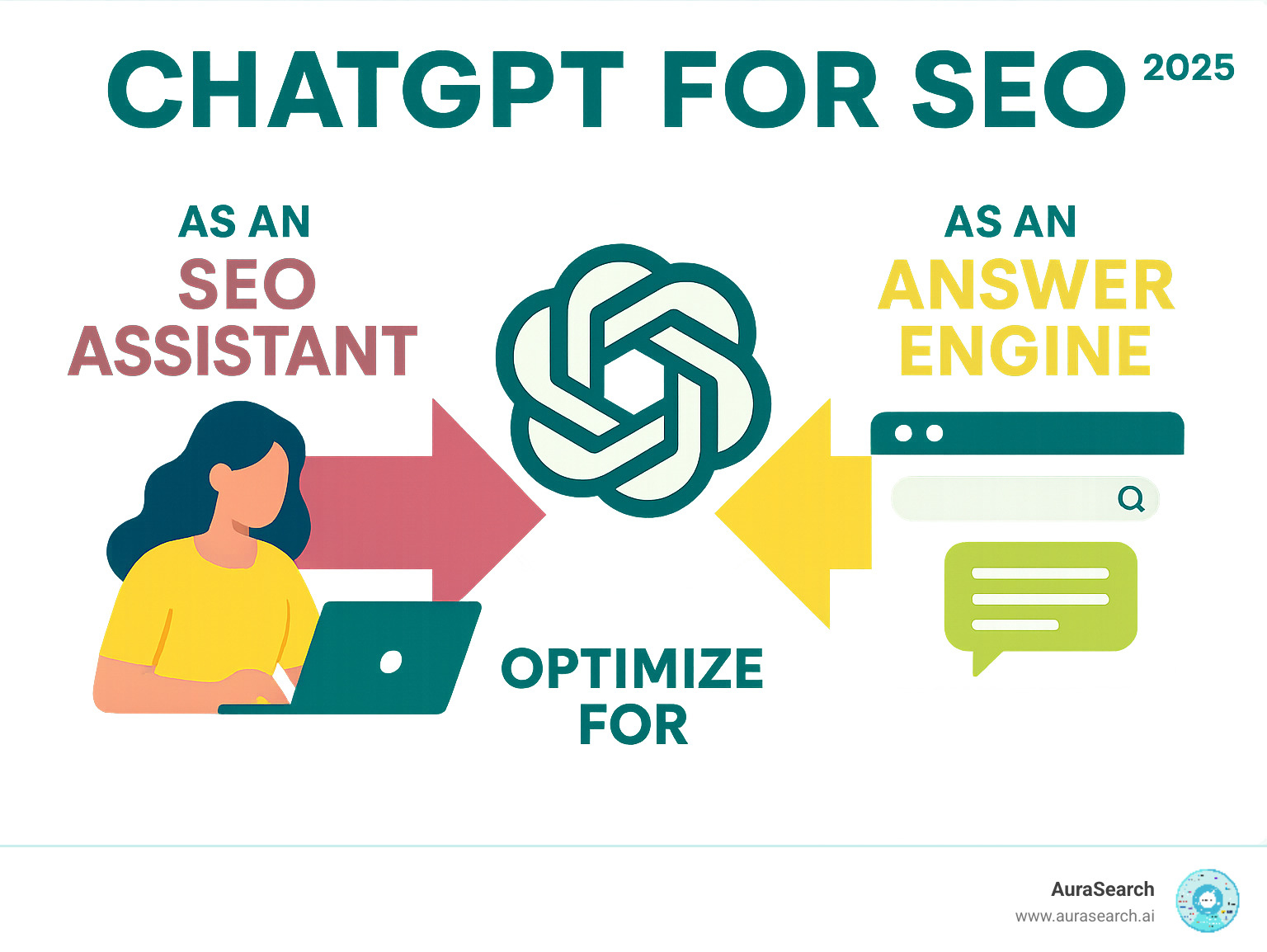
The world of SEO is changing, with AI tools like ChatGPT at the forefront. Using ChatGPT for SEO serves a dual purpose: it's a powerful assistant for countless tasks and a new search environment where your content must be visible.
Here's how ChatGPT can be leveraged to boost your SEO efforts:
- Content Creation: Generate articles, blog posts, meta descriptions, and more.
- Keyword Research: Brainstorm ideas, cluster keywords by intent, and find long-tail queries.
- Technical SEO: Assist with schema markup, robots.txt rules, and other technical elements.
- Content Optimization: Refine content for featured snippets and improve existing pieces.
- Strategic Planning: Get ideas for content calendars and competitor analysis.
Built on advanced Large Language Models (LLMs), ChatGPT uses generative AI to produce human-like text, helping you create content and analyze information in novel ways. It acts as a conversational partner for complex SEO challenges.
Beyond being a tool, ChatGPT and similar AI models are new answer engines. Your content must now be visible in AI-generated answers, not just traditional search results. This guide will show you how to achieve both.
Using ChatGPT as Your AI-Powered SEO Assistant
AI is no longer sci-fi; it's a trusted partner for SEO professionals. A reported 86% of SEOs use tools like ChatGPT for SEO to boost efficiency across the entire content lifecycle, from ideation to optimization.
The key to open uping ChatGPT's potential is "prompt engineering"—learning to ask the right questions. Clear, specific instructions guide the AI to handle time-consuming tasks. While it can't execute an entire SEO strategy alone, it's a powerful assistant and an excellent starting point.

Streamlining Keyword Research with ChatGPT for SEO
Keyword research is a foundational SEO task where ChatGPT excels. While it can't provide search volume or difficulty scores (always verify its data), it's a master at brainstorming ideas and understanding user intent.
Here’s how we can leverage ChatGPT for SEO in our keyword quests:
For keyword brainstorming , you can provide your industry, and ChatGPT will generate a categorized list of seed keywords to get you started.
ChatGPT excels at generating long-tail queries . These specific, often question-based phrases target niche audiences and are typically less competitive but highly relevant.
To signal deeper relevance to search engines, ChatGPT can generate semantic and LSI keywords . Google uses these related terms to better grasp the full context of your page.
Keyword clustering is another strength. ChatGPT can analyze a list of keywords and organize them into clear semantic and thematic clusters, helping you structure your content strategy around user needs.
Here are 5 powerful prompts for keyword research with ChatGPT for SEO :
- "Act as an expert SEO strategist for a business in the 'sustainable pet food' niche. Generate a categorized list of 20 seed keywords covering product types, ingredients, and customer concerns."
- "For the head term 'organic dog food', generate 15 long-tail keyword variations phrased as questions that a potential customer might ask."
- "For the primary keyword 'best grain-free cat food', list 10 semantically related and LSI keywords. Briefly explain why each term is relevant for an article on this topic."
- "Take this list of keywords: ['hypoallergenic dog treats', 'puppy training snacks', 'low-calorie dog biscuits', 'sensitive stomach dog food']. Group them into semantic clusters based on user intent or topic."
- "Analyze the search intent (informational, commercial, transactional) and suggest an ideal content type (e.g., blog post, product page) for these keywords: 'how to choose a dog bed', 'buy orthopedic dog bed', 'large dog bed reviews'. Present the analysis in a table."
Accelerating Content Creation and Optimization
With keywords ready, ChatGPT for SEO accelerates content creation and optimization. It acts as a fast writing assistant, freeing you to focus on adding unique human insights.
It can generate comprehensive content outlines and basic briefs, draft sections of articles to overcome writer's block, and quickly craft meta descriptions and title tag ideas that adhere to character limits.
ChatGPT can also generate relevant FAQs for any article, which can help you appear in "People Also Ask" features. For content rewriting and tone adjustment , it can rephrase paragraphs to improve readability or match your brand's voice.
For featured snippet optimization , it can draft concise (40-60 word) answers to specific queries. It can also help create optimized YouTube descriptions that are valuable and include relevant keywords.
Remember Google's stance: AI content is acceptable if it provides value. Always review, fact-check, and edit AI-generated text to ensure it is accurate, original, and meets high-quality standards.
More info about our AI Blog services
Simplifying Technical SEO Tasks
ChatGPT for SEO can also assist with technical tasks, helping generate and troubleshoot code and rules.
Schema markup helps search engines understand your content, leading to rich snippets. ChatGPT can generate JSON-LD schema for articles, FAQs, and more. What is Schema markup? Always validate the output with a tool like the Schema Markup Validator to ensure it's error-free.
It can generate Robots.txt rules to manage your crawl budget, but be careful—an error could block important pages. Always test these rules before deployment.
For multilingual sites, ChatGPT can assist in generating complex Hreflang tags , though careful verification is still required.
It can also help generate .htaccess redirects (like 301s) to preserve SEO value when URLs change, simplifying a technical task.
For advanced users, ChatGPT can create RegEx (Regular Expressions) patterns for filtering data in tools like Google Search Console, helping you extract specific insights.
How to Get Your Content Featured in AI-Powered Search
The search landscape is shifting towards Answer Engine Optimization (AEO), which focuses on getting your content cited directly by AI models like ChatGPT for SEO . Instead of just appearing in search results, your content becomes the answer , building immediate trust.
Given Microsoft's investment in OpenAI, ChatGPT's results often show high similarity to Bing's (reportedly around 73%). Therefore, optimizing for Bing is a strategic move for improving visibility in AI answers.
The Importance of Visibility in AI Search
AI models select sources based on accuracy, structure, reputation, and relevance. They often weigh the direct trustworthiness of the content itself more heavily than traditional signals like backlinks. Your content must be credible and directly answer a user's query.
To get noticed in AI search, you need to:
- Optimize for AI-driven platforms: Since ChatGPT often uses Bing, improving your Bing rankings is a priority. Use Bing Webmaster Tools and apply solid SEO practices.
- Ensure your site is findable by AI: Use crawler tracking tools to see if AI bots like GPTBot are visiting your site. An easily crawlable site is vital.
- Leverage local business listings: For local queries, AI pulls from sources like Yelp and Google Business Profile. Keep your business information accurate and consistent across these platforms.
Optimizing Content Structure and E-E-A-T
Content organization is critical for AI comprehension. AI favors clear, well-structured information.
Use clear headings (H1, H2, H3) in a logical order to help AI quickly identify main topics and sub-topics. Bulleted lists, numbered lists, and data tables are also effective because they break down complex information into digestible pieces that are easy for AI to extract.
E-E-A-T (Expertise, Experience, Authoritativeness, and Trustworthiness) is as crucial for AEO as it is for traditional SEO. To build trust with AI models, you must demonstrate these qualities by:
- Showcasing expertise with author bios and qualifications.
- Demonstrating experience with case studies and first-hand accounts.
- Building authoritativeness through mentions from other trusted sites.
- Fostering trustworthiness with transparency and factual accuracy.
Your human touch is essential to infuse content with genuine E-E-A-T, as AI-generated text lacks experience and true expertise. Also, visuals like custom photos and graphics can help you get noticed in AI answers if they are well-labeled and relevant.
The Role of Off-Page Signals and Local SEO
Off-page signals also influence how AI perceives your brand.
Mentions on news sites, affiliate, and aggregator sites are a major win. AI models often pull information from these respected sources, boosting your chances of being cited.
Backlinks still matter. They signal authority to search engines, which indirectly tells AI that your content is credible. Even unlinked brand mentions can help ChatGPT for SEO recognize your brand.
For local searches, local listings and business profiles are crucial. Claim and optimize your Google Business Profile, Yelp, and other directories. Consistent NAP (Name, Address, Phone) information helps AI confirm your business's legitimacy and location.
Best Practices & Ethical Considerations for using ChatGPT for SEO
Using ChatGPT for SEO requires responsibility. To succeed, you must practice responsible AI use, avoid search engine penalties, maintain your brand voice, and ensure human oversight.

Adhering to Search Engine Quality Guidelines
Google's stance on AI content is clear: quality and helpfulness matter most. The focus must always be on creating people-first content.
Accept a "people-first" approach by ensuring all published content is original, high-quality, and valuable to your audience. This aligns with Google's concept of creating helpful, reliable, people-first content.
At the same time, you must avoid spam . Using AI to produce low-quality, repetitive content to manipulate rankings risks penalties. Use AI as an assistant to improve content, not to create junk.
The best way to stand out is by adding unique value . AI compiles existing information, but it cannot replicate your unique insights, experiences, or deep research. This human touch is irreplaceable.
Overcoming ChatGPT's Limitations
To use ChatGPT effectively, you must understand its limitations.
First, be aware of the knowledge cutoff date . ChatGPT's training data is not live, so it won't know about the very latest events or algorithm updates. For example, GPT-4's knowledge is limited to information available before April 2023.
This leads to the need for rigorous fact-checking . ChatGPT can sometimes present false information as fact, a phenomenon known as "AI hallucinations." Never blindly trust its output, especially statistics or factual claims.
Another key issue is its lack of real-time data . It cannot provide current search volumes, keyword difficulty, or live SERP data, which is why traditional SEO tools remain indispensable for data-driven analysis.
The best approach is to use ChatGPT for SEO as a starting point, not a final product . It's a powerful assistant for brainstorming and drafting, but human expertise, refinement, and strategic alignment are what transform a draft into great content.
Frequently Asked Questions about ChatGPT and SEO
How can I track my website's performance within AI-powered search?
Tracking performance in AI search is still evolving, as there is no dedicated "AI Search Console" yet. However, you can monitor your visibility through several methods:
- Manual Queries: Directly ask ChatGPT and other AI models questions relevant to your business to see if your brand or content is cited.
- Brand Mention Monitoring: Track unlinked brand mentions across the web, as these are signals of authority to AI.
- Specialized Tools: Emerging SEO platforms are beginning to offer features to track visibility within AI responses.
- Bing Rankings: Since ChatGPT's results often correlate with Bing's, monitoring your Bing rankings is a smart proxy.
- Crawler Activity: Use log monitoring tools to see if AI-specific crawlers like GPTBot are visiting your site, which indicates your content is being indexed for AI use.
While it requires vigilance, tracking your AI search presence is achievable.
Will ChatGPT and other AI tools replace traditional search engines?
No. We see a future of coexistence , where AI chat and traditional search engines form a hybrid experience. They serve different, complementary user needs. Traditional search is excellent for exploration and research across multiple links, while AI models provide direct, conversational answers and summaries.
Google's own integration of AI Overviews into its search results confirms this hybrid model. The future isn't about replacement but a blend of link-based results and AI-generated answers. While popular, ChatGPT's traffic is a small fraction of Google's, indicating that traditional search remains dominant. Our job is to optimize for both sides of this evolving landscape.
What is the difference between using ChatGPT and traditional SEO tools?
ChatGPT for SEO and traditional SEO tools are not rivals but a complementary duo, each with distinct strengths.
-
ChatGPT's Strengths: It excels at ideation and content generation . Use it for brainstorming ideas, drafting outlines, writing copy, rewriting content, and generating meta tags or FAQs. It's your creative assistant.
-
Traditional SEO Tool Strengths: These are data analysis powerhouses . They provide real-time, accurate data on search volume, keyword difficulty, backlink profiles, and rankings. They are essential for data-driven decisions, competitive analysis, and technical site audits.
-
How They Work Together: Use ChatGPT to generate creative ideas and content drafts. Then, use traditional SEO tools to validate those ideas with hard data, analyze competitors, and track performance. For example, ChatGPT can generate schema code, but a traditional tool can audit your entire site for technical errors.
Human oversight is essential for both. With ChatGPT, you provide strategic direction and quality control. With traditional tools, you interpret data and implement strategy. Using them together creates a powerful, effective SEO workflow.
Conclusion: Embracing the Future of AI-Driven SEO
AI is reshaping the search landscape, making ChatGPT for SEO a strategic necessity for businesses aiming to thrive online.
We've explored ChatGPT's dual role: as a powerful AI assistant for tasks like keyword research and content creation, and as a new "answer engine" where your content must be optimized for direct citation.
The future is a hybrid of traditional search and AI-powered conversations. Success requires adapting your strategy to include Answer Engine Optimization (AEO) alongside conventional SEO, focusing on high-quality, well-structured, authoritative content that both humans and AI can trust.
Crucially, AI tools don't replace the human touch. Your unique insights, critical thinking, and brand voice are irreplaceable and will make your content stand out from anything AI can generate on its own.
At AuraSearch, we are passionate about helping businesses steer this new era. We combine cutting-edge AI SEO services with crucial human expertise. Our mission is to ensure your content not only ranks in traditional search but is also featured in new AI platforms like ChatGPT and Google AI Overviews.
Ready to make your mark in the AI-driven search world?