Why AI-Powered Conversational Search Optimization Is Reshaping Digital Visibility

AI-powered conversational search optimization is structuring your content so AI systems like ChatGPT, Google's AI Overviews, and Perplexity can understand, extract, and cite it in their responses. Here's what it involves:
- Structuring content using question-based headings and clear, direct answers
- Building authority through E-E-A-T signals (Experience, Expertise, Authoritativeness, Trust)
- Making content "quote-worthy" with concise definitions and unique data
- Using schema markup to help AI understand your content's context
- Optimizing for natural language instead of just keywords
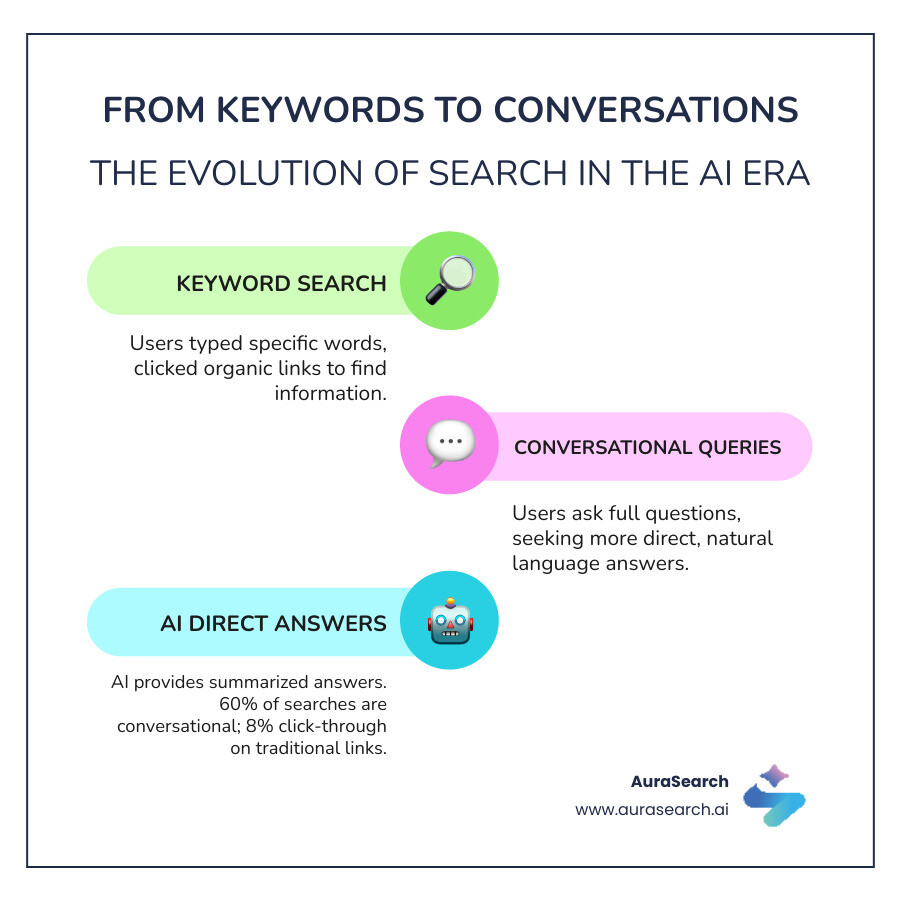
Search has changed. With generative AI summaries on the SERP, traditional links are clicked only about 8% of the time. Over half of searches now result in zero clicks because AI provides direct answers.
This isn't a distant future trend. 60% of online searches are now conversational , and 52% of Americans actively use AI tools like ChatGPT. By 2028, $750 billion in US revenue will funnel through AI-powered search.
If your rankings are high but traffic is declining, this is why. Users now ask detailed questions like, "What's the best CRM for a small real estate agency under $100/month?" and get answers without visiting your site.
The good news is that you can adapt. Traditional SEO is evolving, not dead. Quality content, clear structure, and user focus still matter, but you must now optimize for how AI understands and cites your content.
Ai-powered conversational search optimization terms to remember:
- artificial intelligence seo
- AI SEO specialist
- AI competitor analysis
The Shift to Conversation: Why Traditional SEO Isn't Enough
The digital landscape is undergoing a tectonic shift, and we're at the epicenter. For years, traditional SEO focused on keywords, rankings, and driving clicks. Our goal was to get our content to the top of the search results page, knowing that a higher position meant more traffic. But with the rise of AI-powered conversational search optimization , those rules are being rewritten.
Consider the fundamental difference:
| Traditional SEO | Conversational Search Optimization (CSO) |
|---|---|
| Focus on Keywords | Focus on User Intent, Natural Language |
| Aim for High Rankings | Aim for Citations, Direct Answers |
| Measure Clicks | Measure Mentions, Zero-Click Answers |
| Optimize for Search Engines | Optimize for Conversational AI Platforms |
The shift is clear: "More than half of searches don’t lead to clicks" because AI is designed to deliver direct answers right away. This means that even if our content ranks highly, users might get their answer from an AI summary without ever visiting our site. This phenomenon of "vanishing clicks" is a critical indicator that our strategy needs to evolve.
The consumer decision journey has also transformed. Over 70% of AI-powered search users ask questions at the top of the funnel—they're seeking to learn about a category, brand, product, or service. They're not just looking for a product name; they're asking, "What's the best way to choose a reliable service provider for X?" This move towards natural, question-based inquiries means our content needs to be ready to address these detailed, conversational prompts.
As we noted in our Beyond Keywords: Optimising Content for the AI Search Era guide, the game has changed. We're moving from a world where we tried to guess keywords to one where we need to anticipate conversations.
The Challenges of Conversational Search
While AI-powered conversational search optimization offers immense opportunities, it also presents unique challenges:
- Ambiguity and Nuance : AI struggles with sarcasm, idioms, and nuance. Your content must be clear and unambiguous to avoid misinterpretation.
- Context Tracking : Conversations build on previous questions. AI must maintain context, and your content should be structured to support these multi-turn dialogues.
- Multi-Turn Conversations : Users ask follow-up questions. Your content needs to anticipate these and offer layered answers for dynamic interactions.
- Data Sourcing and Reliability : AI synthesizes information from many sources. Your content must be findable and deemed authoritative and reliable to be chosen.
- Misinformation Risk : AI can present misinformation. As creators, we must ensure our content is accurate and transparent, as AI models are sensitive to these signals.
The Alarming Stats: Why You Must Adapt Now
The urgency to adapt to AI-powered conversational search optimization isn't just theoretical; it's backed by startling statistics:
- Traffic Decline : Unprepared brands may experience a significant decline in traffic from traditional search channels—anywhere from 20% to 50%. This isn't just a slight dip; it's a substantial threat to organic visibility.
- Conversational Dominance : A staggering "60% of online searches are now conversational." This isn't a future projection; it's our present reality. As Gen Z and mobile-first users increasingly rely on voice search and AI tools, this number will only continue to rise.
- AI as a Primary Source : Over 44% of AI-powered search users say it's their primary and preferred source of insight. This tops traditional search (31%), retailer or brand websites (9%), and review sites (6%). If our brand isn't visible in AI answers, we're missing out on where a significant portion of consumers are making their decisions.
- Brand Visibility Risk : Traditional brand strength no longer guarantees visibility. Top brands in consumer electronics, grocery, travel, wellness, apparel, beauty, and financial services are sometimes absent from AI answers, even if they dominate traditional search results. This highlights that traditional SEO performance doesn't automatically translate to AI visibility.
The message is clear: if we don't adapt, we risk becoming invisible. As we discussed in our article, AI Search Optimization: Don't Get Left Behind in the Generative Era , the time to act is now.
How Conversational AI Search Works (And What It Wants)
To master AI-powered conversational search optimization , we first need to peek behind the curtain and understand how these intelligent systems operate. At their core are Large Language Models (LLMs), like those powering ChatGPT or Google Gemini. These LLMs are trained on massive datasets—often including sources like Common Crawl —to understand, generate, and process human language.
When we ask a question, the AI doesn't just look for exact keyword matches. It performs a process akin to what we call Retrieval-Augmented Generation (RAG). It first uses sophisticated semantic search to understand the meaning and intent behind our query. Then, it retrieves relevant information from its vast knowledge base and the live web, much like Google co-founder Sergey Brin described as "retrieving the top thousand search results, then running follow-on searches to refine and analyze them."
AI systems also organize information around entities, topics, and questions, rather than just query strings. This means they understand the relationships between people, places, and concepts. For our content to be truly effective, it needs to speak this language of entities and semantic relevance.
Crucially, AI models assess the credibility of their sources. This is where E-E-A-T signals (Experience, Expertise, Authoritativeness, and Trustworthiness) come into play. Generative systems use these signals to decide which sources to reference, especially for "Your Money or Your Life" (YMYL) topics where accuracy is paramount. Building strong E-E-A-T signals is no longer just good SEO; it's a prerequisite for AI visibility. Our guide on Navigating AI Overviews: Your SEO Survival Guide digs deeper into this.
The Critical Role of User Intent and Natural Language
At the heart of AI-powered conversational search optimization is a deep understanding of user intent and the nuances of natural language. Unlike traditional keyword searches, where a user might type "running shoes," a conversational query is more likely to be "What are the best running shoes for flat feet for under $100?"
AI systems classify user intent into categories like:
- Informational Intent : Users seeking answers to questions ("How do I fix a leaky faucet?").
- Navigational Intent : Users looking for a specific website or location ("Go to AuraSearch.ai").
- Transactional Intent : Users wanting to complete an action, like making a purchase ("Buy a new laptop").
The beauty of conversational AI is its ability to interpret these intents, even when expressed in complex, natural language. It moves beyond exact keyword matching to understand the underlying need. This means our content must be designed to directly address these various intents, offering clear, concise answers to questions users would ask a person.
Furthermore, conversational search thrives on multi-turn interactions. Users often ask follow-up questions to refine their initial query or dive deeper into a topic. Our content needs to anticipate these subsequent questions and provide layered answers that guide the user through a logical information flow. Writing with user intent and conversational flow in mind is how we speak the same language as AI.
Behind the Curtain: How AI Models Source and Synthesize Answers

When we ask an AI a question, it doesn't just pick one website and regurgitate its content. Instead, it performs a complex dance of sourcing and synthesizing information from multiple web pages to create a single, coherent summary. This process is crucial to understand for effective AI-powered conversational search optimization .
Here's a simplified look at what happens:
- Web Crawling
: AI systems use dedicated web crawlers (like GPTBot and CCBot) to index web content. Like Googlebot, they must be able to access your site, so ensure your
robots.txtfile allows them. - Information Retrieval : When a query is made, the AI retrieves relevant documents, prioritizing pages with high traditional rankings and strong E-E-A-T signals.
- API Calls and Knowledge Graphs : Some models use API calls to knowledge graphs or search results to access structured, verified information.
- Synthesis and Generation : The AI synthesizes the retrieved information into a new, original answer. It combines and rephrases content to provide a direct, conversational response, rather than just copying it.
- Citation Generation : Finally, the AI generates citations, linking to the authoritative sources it used. Our goal, as outlined in our Generative Engine Optimisation guide, is to become a cited source.
The challenge for us is to ensure our content is easily "parsable" and trustworthy enough for the AI to select it during this complex synthesis process.
Your Blueprint for AI-Powered Conversational Search Optimization
Navigating this new world of search requires a clear strategy. We're not just doing SEO anymore; we're engaging in AI-powered conversational search optimization , which encompasses both Answer Engine Optimization (AEO) and Generative Engine Optimization (GEO). AEO focuses on optimizing for AI-integrated traditional search engines (like Bing's AI features), while GEO targets the conversational AI platforms directly (like ChatGPT or Google's AI Overviews).
Our blueprint for success revolves around making our content irresistible to AI systems. This means carefully planning our content structure, leveraging schema markup, and ensuring our expertise shines through. As we highlighted in AI's New Frontier: How to Optimize for Generative Search , we need to think beyond keywords and towards being the definitive answer.
Here's our step-by-step guide:

1. Structure Content for AI-Powered Conversational Search Optimization
The way we organize our content is fundamental to how AI understands and extracts information. Think of it as writing for a very smart, very literal robot.
- Question-Based Headings : Use explicit questions as headings, like "What are the key benefits of CRM automation?" instead of "CRM Benefits." This helps AI match content to user queries.
- Inverted Pyramid Style : Follow the inverted pyramid style: provide a direct answer right after the heading, then elaborate. This answer-first approach is ideal for AI snippets.
- TL;DR Summaries : Consider adding a 1-2 sentence "Too Long; Didn't Read" summary under key H2s or at the top of an article. This standalone summary can be easily excerpted by AI.
- Tools for Authentic Questions : Use tools like AlsoAsked or AnswerThePublic to uncover the authentic questions users are typing or asking. Frame our content directly as answers to these questions.
- FAQ Sections : Dedicated FAQ sections are goldmines for AI. They provide clear, question-and-answer pairs that AI can easily parse and present in its summaries.
- Clear Definitions : Always include clear, plain-language definitions before introducing nuance or complex concepts. This provides foundational understanding for both AI and human readers.
This structured approach ensures our content is easy to extract, summarize, and reuse by AI, making it "AI-friendly." Our guide on What is Content Optimization and How AI Transforms It offers more insights into this change.
2. Become 'Quote-Worthy' for AI Summaries
To be cited by AI, our content needs to be not just informative, but inherently "quote-worthy." AI systems are looking for definitive answers, unique insights, and verifiable facts they can confidently attribute.
- Concise Definitions : Offer concise definitions. For example: "AI-powered conversational search optimization is tailoring content for how people use AI search tools."
- Unique Data and Statistics : Use specific, sourced data. AI is attracted to factual density, like "Email marketing generates $42 for every $1 spent, according to Litmus’s 2024 research."
- Expert Quotes : Integrate quotes from industry experts, customers, or company founders. These add credibility and a human touch, which AI values.
- Actionable Takeaways : Break down complex information into clear, actionable steps. AI often summarizes "how-to" content, and bulleted or numbered lists are perfect for this.
- Short, Quotable Paragraphs : Write paragraphs that are concise and can stand alone. If an AI wants to extract a key point, it should be able to do so without losing context.
By consistently creating content that is factual, well-supported, and easy to extract, we increase our chances of being cited in AI summaries and overviews. This is the essence of AI Overview Optimisation.
3. Leverage AI Tools for Smarter Content Creation
In the age of AI-powered conversational search optimization , we don't just optimize for AI; we can also leverage AI to optimize our content creation process. AI tools are not here to replace us, but to augment our capabilities, helping us work smarter and faster.
- Content Brief Generation : AI tools can quickly analyze search trends, competitor content, and user questions to generate comprehensive content briefs. This saves us hours of research, allowing us to focus on crafting high-quality content.
- Prompt Engineering : Mastering prompt engineering for LLMs allows us to guide AI to generate relevant ideas, outlines, and initial drafts that align with our conversational search goals. We can ask AI to "generate an FAQ section for a blog post about X" or "outline a multi-turn conversation about Y."
- Topic Clustering : AI can help identify semantic relationships between topics and suggest content clusters. This allows us to build authoritative pillar pages and supporting cluster content, signaling to AI that we are an expert source on a subject.
- AI-Assisted Editing : While human oversight is crucial, AI can assist with editing, proofreading, optimizing for tone, and suggesting ways to make content more concise and conversational.
- Human-in-the-Loop Workflow : Use a "human-in-the-loop" workflow. Let AI generate drafts, but have human experts refine, fact-check, and add unique insights. This ensures the quality and trustworthiness that AI models prioritize.
Repurposing AI-generated content into voice assistant scripts or chatbot replies can further extend our reach across conversational platforms. Our guide, From Keywords to Content: How ChatGPT Can Supercharge Your SEO Efforts , explores this in more detail.
4. Optimize for Major AI-Powered Search Platforms
Just as we optimize for Google differently than for Bing in traditional SEO, we need to consider the nuances of various AI platforms for effective AI-powered conversational search optimization . Each AI model has unique characteristics that affect how it consumes and presents information.
Here’s a general list of optimization tips, keeping platform-specific nuances in mind:
- E-E-A-T (Experience, Expertise, Authoritativeness, Trust) : Universally critical, especially for Google platforms. Ensure clear author bios, first-hand experience, and original visuals to build strong E-E-A-T.
- Structured Data (Schema Markup) : Essential for all platforms. Use Article, Organization, Author, FAQ, and How-To schema to provide context. Verify it with Google's Rich Results Test.
- Conversational Tone : ChatGPT thrives on a conversational tone, comprehensive coverage, clear structure, and practical examples. Write as if speaking directly to the user.
- Comprehensiveness and Clarity : For all platforms, provide clear, concise answers to common questions. Claude emphasizes analytical depth, source citations, and balanced viewpoints. Perplexity AI prioritizes recent information, clear citations, factual density, statistical data, and direct answers.
- Platform-Specific Nuances
:
- Google AI Overviews/SGE : Focus on being the definitive answer to a question. Ensure content is factual, well-structured, and directly answers common user questions.
- ChatGPT : Optimize for natural language and multi-turn conversations. Provide comprehensive, yet digestible, information.
- Perplexity AI : Prioritize recency and strong citations. If our content is data-heavy or research-driven, ensure it's up-to-date and clearly sourced.
- Bing Chat/Copilot : Leverage its web search integration by ensuring our traditional SEO is strong, and our content is optimized for commercial intent where applicable.
By understanding these distinctions, we can tailor our content to maximize its visibility across the diverse landscape of AI search. Our article on AI Search Optimization Strategies to Boost Your Visibility offers more detailed guidance.
Measure What Matters: Tracking Success & Dodging Pitfalls
In the brave new world of AI-powered conversational search optimization , what gets measured gets managed. But the metrics themselves are shifting. We're moving beyond just clicks and rankings to understanding AI visibility, brand mentions, and the impact of zero-click answers.
Only 16% of brands today systematically track AI search performance, which means there's a huge opportunity for us to gain a competitive edge. AI citations and impressions often precede direct engagement, shaping consideration even without a click.
Measuring Your AI-Powered Conversational Search Optimization Efforts
To effectively measure our efforts, we need to adapt our analytics strategy:
- Custom Segments in Analytics : Set up custom segments in Google Analytics (or our preferred analytics platform) to identify traffic originating from AI sources. While direct attribution can be tricky, we can look for referral patterns from AI platforms or specific user behaviors characteristic of AI-driven traffic.
- Search Console Performance Reports : Google Search Console remains invaluable. Monitor impressions for conversational queries, observe which pages are gaining featured snippets (often a source for AI answers), and track any new "AI Overview" or "Generative Experience" sections that Google might introduce in its reporting.
- Tracking Appearances in AI Overviews : Actively search for our target keywords and phrases in Google AI Overviews and other generative AI platforms. Track how often our content is cited, summarized, or directly linked. This "citation tracking" is a key metric.
- Rank Tracking for Conversational Queries : While traditional keyword rankings are still important, we need to expand our rank tracking to include long-tail, conversational questions. Tools that show us where our content appears in "People Also Ask" sections or as direct answers are crucial.
- Conversion Rate from AI Sources : We want to know if AI-driven visibility is translating into business outcomes. Track conversion rates for users who arrive via AI-related channels. Are they more qualified? Do they convert faster?
Common Pitfalls to Avoid
As with any new frontier, there are pitfalls we must avoid to ensure our AI-powered conversational search optimization efforts are successful:
- Blocking AI Crawlers (robots.txt)
: Don't block AI crawlers like GPTBot or CCBot. Regularly review your
robots.txtfile and use a Robots.txt checker to ensure they can access your content. - Neglecting Structured Data : Failing to implement or update structured data (schema markup) denies AI the context it needs. Always "Check our structured data with Google's Rich Results Test" to ensure it's working.
- Creating Generic, AI-Only Content : Relying solely on AI for content creation is a mistake. Generic content lacks the unique insights, brand voice, and E-E-A-T signals that AI systems value.
- Ignoring E-E-A-T : Content lacking strong Experience, Expertise, Authoritativeness, and Trust signals will be deprioritized by AI models seeking reliable sources.
- Inconsistent NAP for Local Search : For local businesses, inconsistent Name, Address, and Phone (NAP) information confuses AI in "near me" searches. Ensure all local data is consistent.
Frequently Asked Questions about Conversational Search
What is the main difference between traditional SEO and conversational search optimization?
Traditional SEO focuses on ranking for specific keywords to earn clicks. Conversational search optimization focuses on providing direct, clear answers to natural language questions to be featured or cited in AI-generated responses, where a click is not the primary goal.
How do I make my content appear in AI-powered search overviews?
Focus on creating clear, factual, and well-structured content that directly answers common user questions. Reinforce your content with strong E-E-A-T signals (Experience, Expertise, Authoritativeness, Trust), use relevant structured data, and ensure your answers are concise and easy for the AI to extract.
Can I use AI to write all my content for conversational search?
While AI tools can significantly speed up content creation, relying on them exclusively is a pitfall. Best practice involves a "human-in-the-loop" approach, where AI generates drafts that are then edited, fact-checked, and improved with unique human expertise and brand voice to ensure quality and trustworthiness.
Conclusion: The Future is a Conversation
The world of search is no longer just about keywords and rankings; it's about conversations, intent, and being the trusted source for AI-generated answers. AI-powered conversational search optimization isn't a fleeting trend; it's the new reality that reshapes how users find information and make decisions.
We've seen that traditional SEO isn't dead, but it has evolved. Our content needs to be structured for AI, designed to be "quote-worthy," and infused with human expertise and unique data. We must understand how AI models source and synthesize information, and adapt our strategies to meet the specific demands of platforms like Google AI Overviews, ChatGPT, and others.
The future of search is conversational, and mastering it is key to our brand's visibility. This isn't just about adapting to new technology; it's about continuing to provide immense value to our audience in the most accessible and natural way possible. Our team at AuraSearch™ specializes in this evolving landscape, offering expert generative AI SEO services to help businesses like yours steer and win in the AI era.