The Unstoppable Rise of Voice Search
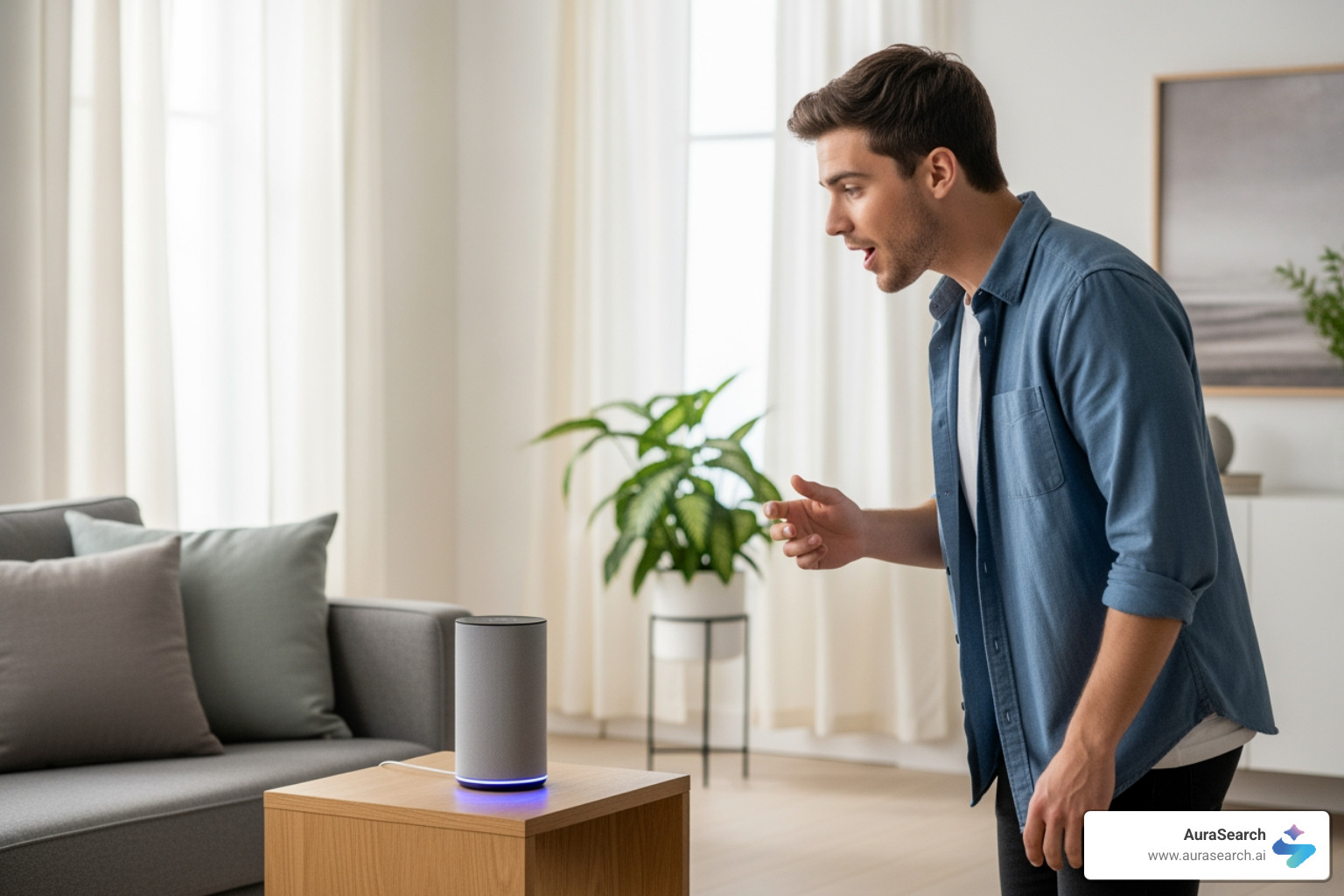
AI and voice search optimization is changing how people find information online. Instead of typing keywords, users now speak naturally to Siri, Alexa, and Google Assistant, and businesses need to adapt fast.
Quick Answer: How to Optimize for AI-Powered Voice Search
- Use conversational, long-tail keywords that match how people actually speak
- Optimize for featured snippets with concise 20-40 word answers
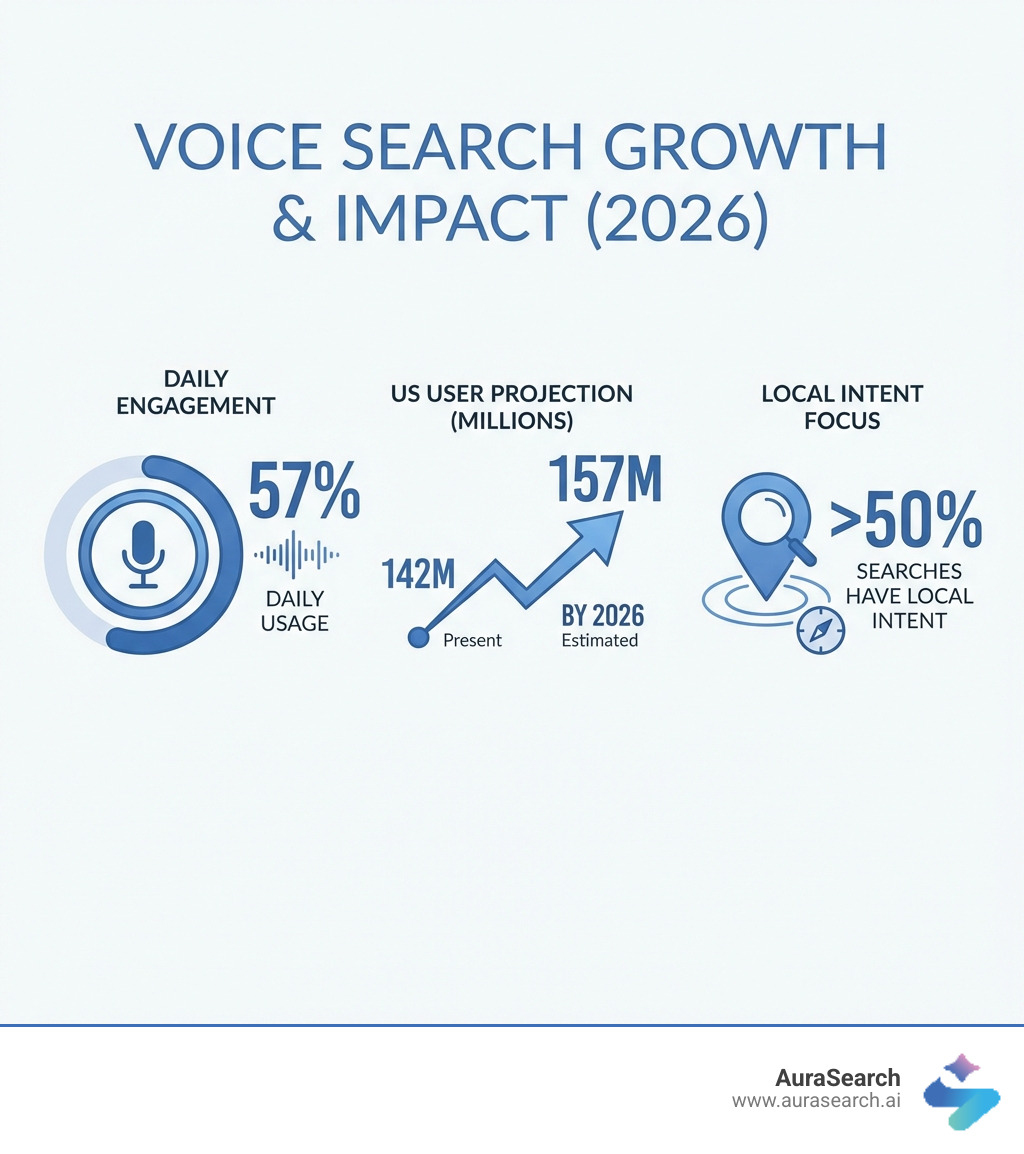
- Focus on local SEO since over 50% of voice searches have local intent
- Improve page speed because voice assistants prioritize fast-loading sites
- Add structured data (schema markup) to help AI understand your content
- Create FAQ-style content that directly answers common questions
The numbers tell a compelling story. 57% of voice command users engage with this feature daily. The global voice search market, valued at $3.05 billion in 2023, is projected to hit $13.88 billion by 2030, with a compound annual growth rate of 23.8%.
This is not just about smart speakers anymore. Voice search happens everywhere: in cars, on phones, through TVs, and across smart home devices. More than 8.4 billion voice assistants are in use today worldwide.
For businesses, this shift is critical. When someone asks "Where's the best coffee shop near me?" they are not scrolling through ten blue links. They are expecting one immediate answer. If your business is not optimized for voice search, you are invisible to millions of potential customers.
The challenge is that voice queries are fundamentally different from typed searches. People do not say "pizza restaurant NYC"; they ask "Where can I get the best pizza delivered tonight?" This conversational shift, powered by AI, requires a rethinking of content strategy.
Key terms for ai and voice search optimization :
How AI is Rewriting the Rules of Voice Search
Artificial intelligence is not just a player; it is the MVP in the game of voice search. AI algorithms, particularly those leveraging Natural Language Processing (NLP) and machine learning, are fundamentally changing how voice search works and, by extension, how we optimize for it. Systems like Google's RankBrain and BERT allow search engines to move beyond simple keyword matching to understand the meaning and intent behind a user's spoken query.
AI helps voice assistants interpret conversational queries, handle diverse accents and dialects with high accuracy, and learn user preferences over time. The result is more accurate, personalized, and contextually relevant answers delivered directly to the user. The emergence of generative AI has significantly boosted the viability and adoption of voice search; what was once speculative is now a mainstream reality.
For a deeper dive into how AI is reshaping the entire SEO landscape, explore AI in SEO: Your Essential Guide.
The Shift from Keywords to Conversations
In the early days of SEO, strategies often relied on repeating target keywords throughout a page. In the era of ai and voice search optimization , that approach no longer works.
Voice queries are inherently conversational. Instead of typing "best Italian restaurant NYC," a user might ask, "Hey Google, what's the best Italian restaurant near me that's open now?" This is a long-tail, natural language query packed with context and intent. AI-powered algorithms are designed to understand full sentences, not just isolated keywords.
This shift means content needs to mirror how people naturally speak and ask questions. The focus moves to semantic search, which is about understanding the meaning and relationships between words rather than the exact phrasing. It is about anticipating the user's journey and providing answers that flow like a natural conversation.
Traditional "money" keywords are seeing a decline in search volume, while the importance of semantic context is rising. Learn more about adapting your content for this new era in More on optimizing for the new search era.
AI's Role in Understanding User Intent
One of AI's most significant contributions to voice search is its ability to decode user intent. When a user speaks a query, AI does not just convert the audio to text; it analyzes the underlying purpose. Is the user looking for information (informational intent), trying to reach a specific website or location (navigational intent), looking to make a purchase (transactional intent), or seeking something nearby (local intent)?
AI's advanced NLP capabilities allow it to decipher these nuances. For example, if someone asks, "How do I change a flat tire on a 2022 Honda Civic?" AI understands they need instructional content. If they ask, "Where can I get my bike fixed near me that's open on Sundays?" AI recognizes the local and time-sensitive transactional intent.
This intelligence extends to handling accents, regional dialects, and even background noise, making voice assistants versatile across different contexts.
For content to be effective in voice search, it must clearly address these different types of intent. If content is vague or does not directly answer a user's implied question, AI is less likely to surface it. The shift from keyword-based tactics to NLP makes AI search optimization crucial , because AI now interprets not just the words, but the intent and context behind them.
Voice vs. Text Search: Understanding the Key Differences
While both voice and text search aim to deliver relevant information, the way users interact with them, and therefore how we optimize for them, is fundamentally different. It's like comparing a formal written letter to a casual chat with a friend – both convey information, but the style and expectations differ greatly.

Here's a breakdown of the key distinctions:
| Feature | Traditional Text Search | Voice Search |
|---|---|---|
| Query Length | Short, 1-3 words (e.g., "best pizza NYC") | Longer, 3-5+ words, conversational (e.g., "Where can I find the best pizza near me?") |
| Query Structure | Keyword-based, often fragmented | Natural language, full questions (e.g., "What," "How," "Where") |
| User Intent | Broad (informational, navigational, transactional) | Often immediate and action-oriented (e.g., "Call Mom," "Directions to...") |
| Local Intent | High, but not always explicit | Very high, with frequent use of "near me" or implied location |
| Result Format | List of 10 blue links, ads, carousels | Single, direct answer (often from a Featured Snippet) |
| Device | Desktop, mobile | Smart speakers, smartphones, in-car systems |
| Context | Less context-dependent | Highly contextual (time of day, location, user history) |
Your Action Plan for AI and Voice Search Optimization
Optimizing for ai and voice search optimization is an ongoing commitment to understanding how people interact with technology and delivering the answers they need. This action plan covers three critical pillars: content strategy, local SEO, and technical SEO. Each plays a vital role in ensuring your brand is not just seen, but heard.
To master this, it helps to understand how AI transforms content itself. For more insights, read What is Content Optimization and How AI Transforms It.
Crafting Content for Conversational Queries
The core of voice search optimization lies in creating content that speaks directly to the user's spoken queries. Think of your content as having a conversation with the user through their voice assistant.
Here is how to craft content that AI voice assistants favor:
- Focus on long-tail, conversational keywords : Voice queries tend to be longer than typed searches. Move beyond single keywords and target full, natural language phrases. Use question words like "how," "what," "where," "when," and "why." Tools like AnswerThePublic and Google's "People Also Ask" (PAA) sections can help identify these conversational queries.
- Build content around real questions : Start sections with a question and follow with a direct, concise answer. This makes your content highly "speakable." For example, if your heading is "What are the benefits of meditation?" the first paragraph should directly answer that question.
- Optimize for Featured Snippets and PAA : Voice assistants frequently pull their answers from Google's Featured Snippets and PAA boxes. To capture these, structure your content with clear, concise answers, often 20-40 words long, using bullet points, numbered lists, or short paragraphs.
- Write for readability : Voice assistants prefer content that is easy to understand. Aim for a reading level that most users can follow. Avoid jargon, complex sentences, and filler words. Tools like Hemingway to check readability can be helpful.
- Use a conversational tone : Your writing should sound natural when read aloud. Imagine you are explaining something to a colleague or customer. This dialogue-based style works well for voice search.
- Create clear hierarchies : Use H1, H2, and H3 headings to organize your content logically. H1 can mirror the primary question, H2s can address related sub-questions (such as PAA suggestions), and H3s can provide supporting details. AI assistants use these headings to quickly understand your content's structure.
- Deliver concise responses : Front-load crucial information within the first sentence or two of each answer. Use short paragraphs, bullet points, and numbered lists. Remove any unnecessary words or redundant explanations.
- Build topic clusters and internal links : Search engines evaluate expertise across interconnected content, not just isolated pages. Create topic clusters with a pillar page that broadly covers a topic and supporting pages that answer specific questions. Link these pages to create an interconnected knowledge network. This helps AI understand your site's authority on a subject.
Leveraging Local SEO for "Near Me" Dominance
When people use voice search, they often have immediate, local needs. More than half of all voice searches have local intent, meaning users are looking for businesses, services, or information "near me" or "open now." This is where local SEO becomes a powerful part of ai and voice search optimization .

Here are key steps to improve local voice search performance:
- Optimize your Google Business Profiles : Ensure your profile is complete, accurate, and up to date. Include precise business name, address, phone number (NAP), hours of operation, website, photos, and categories. Encourage and respond to customer reviews.
- Keep NAP consistent : Your Name, Address, and Phone Number must be consistent across online directories, your website, and social media profiles.
- Build local citations : Mention your business name, address, and phone number on reputable local platforms and directories.
- Use location-specific keywords : Incorporate local keywords naturally into your website content, title tags, meta descriptions, internal links, and anchor text. Think beyond just your city name; include neighborhoods, landmarks, and regional terms.
- Invest in customer reviews : Positive reviews build trust and signal to both users and AI that your business is reputable. Voice assistants often prioritize businesses with higher ratings and strong review volume.
- Create local content : Develop blog posts or FAQ sections that answer local questions, such as "What are the best attractions near our hotel in [location]?" Custom local content complements your profile and citations.
By carefully optimizing for local search, you increase the chances that when a customer asks their voice assistant for something nearby, your business is the top recommendation.
Essential Technical SEO for AI and Voice Search Optimization
Engaging content will not perform if your website is not technically sound. Technical SEO provides the foundation upon which effective ai and voice search optimization is built. AI and voice assistants prioritize fast, mobile-friendly, and well-structured websites to deliver quick, accurate answers.
Key technical SEO considerations include:
- Page speed : Voice assistants demand immediate answers. Slow sites are unlikely to be chosen. Aim for fast load times, especially on mobile devices. Use Google’s PageSpeed Insights tool to check performance and identify areas for improvement, such as optimizing images, leveraging browser caching, and minimizing code.
- Mobile-friendliness : The majority of voice searches happen on mobile devices. Your website should be responsive, easy to steer on small screens, and free of intrusive pop-ups. Mobile-first indexing means Google primarily uses the mobile version of your content for ranking.
- Structured data (schema markup) : This is like speaking the search engine's language. Structured data is code you add to your site's HTML that helps search engines understand the context and details of your content. For voice search, this is especially useful. Markups such as FAQPage, HowTo, LocalBusiness, Product, and Speakable schema help AI identify exactly what information is on your page. Schema.org provides the vocabulary for this.
- HTTPS : Ensure your website uses HTTPS (Hypertext Transfer Protocol Secure). This encrypts communication between your site and users, builds trust, and can positively influence search rankings.
- Accessibility : Make your site accessible to all users by using alt text for images, supporting keyboard navigation, and choosing clear, readable fonts. Accessibility best practices often align with voice search best practices.
By addressing these technical aspects, you create a robust, AI-friendly foundation that allows your content to perform in voice search results. For more on how these elements fit into the broader AI search landscape, including AI Overviews, see Navigating AI Overviews: Your SEO Survival Guide.
Measuring Success and Peeking into the Future
In ai and voice search optimization , direct measurement can be challenging. Voice assistants often provide a single, spoken answer, which does not always translate into a website click that traditional analytics can easily track. However, that does not mean you are flying blind. You can still use effective methods to measure your Voice Search Optimization (VSO) efforts and prepare for what is coming next.
For a broader perspective on how to optimize for generative AI, see Generative Engine Optimisation.
How to Measure Your VSO Efforts
Although direct attribution is limited, a mix of proxy metrics and analytics tools can show whether your VSO strategies are working:
- Track Featured Snippet rankings : Many voice search answers come from featured snippets. Monitor the keywords for which you appear in these "position zero" spots. If you are ranking for a question-based snippet, you are likely performing well in voice search for that query.
- Use Google Search Console (GSC) : GSC helps you understand organic search performance. Filter your query data for question-based, long-tail, and conversational searches. While GSC does not label voice searches, increased impressions or clicks for queries like "how to fix a leaky faucet" or "where is the nearest pizza place" can indicate successful VSO.
- Monitor long-tail keyword rankings : Because voice queries are longer and more conversational, tracking rankings for these phrases provides insight into voice search visibility.
- Review local pack visibility : For local businesses, monitor appearances in Google's local pack results. Growth in "near me" queries or map pack visibility suggests improved local voice search performance.
- Analyze mobile traffic : Mobile devices account for a large share of voice searches. An increase in mobile organic traffic, especially for question-based queries, can signal that voice optimization is paying off.
- Measure conversions from question-led content : Evaluate the conversion rates for pages optimized around common voice queries, particularly those with local or transactional intent.
The Future of Voice: What Is Next for AI and Search?
The future of voice search is about more than incremental improvements. It reflects a broader shift in how people interact with technology, driven by advances in AI.
- Growth of voice commerce (v-commerce) : Ordering products via voice is becoming more natural, such as asking a smart speaker to reorder household essentials. As trust improves, more purchases will start with a spoken command.
- Deeper Internet of Things (IoT) and smart home integration : Voice assistants increasingly act as command centers for smart homes, cars, and workplaces, from adjusting thermostats to booking services while you drive.
- Multimodal search experiences : Voice will combine with other inputs like images and video. For example, a user might point their camera at an object and ask a question about it. This creates rich, intuitive search experiences.
- Generative AI answers and AI Overviews : Generative AI models enable voice assistants to provide more comprehensive, synthesized answers, often drawing from multiple sources. Google's AI Overviews are an early example of this trend, which makes it important that your content is ready to be summarized.
- Increasing personalization : AI will continue to personalize voice search results based on factors like user habits, location, and preferences. Over time, two users asking the same question may receive different answers custom to their histories.
The convergence of AI, voice, and other technologies is creating an adaptive search journey that is interactive and contextual. To understand how conversational interfaces fit into this evolution, explore The rise of AI chatbots in search.
Real-World Wins: Brands Dominating Voice Search
It's one thing to talk about ai and voice search optimization theory; it's another to see it in action. Several forward-thinking brands have already leveraged AI and VSO to improve customer experience, gain a competitive edge, and drive real business results. Let's look at a couple of inspiring examples.
Domino's: Delivering Pizza Through Voice Commands
Domino's Pizza stands out as a pioneer in integrating voice search into its customer journey. Through its Domino's AnyWare platform , the company allows customers to order pizza using voice commands across various devices, including Google Home, Alexa, and even smartwatches.
This wasn't just a gimmick; it was a strategic move driven by AI-powered SEO. By focusing on conversational AI and voice recognition, Domino's optimized its digital presence to rank higher for voice search queries like "Order pizza near me" or "best pizza deals." The convenience factor was immense: customers could order hands-free while cooking, watching TV, or driving. This significantly improved the customer experience and gave Domino's a competitive advantage in the fast-food industry. Domino's even partnered with Microsoft to further its AI-driven innovation, solidifying its position at the forefront of voice-enabled services.
Sephora: A Voice-Powered Beauty Advisor
Beauty retailer Sephora recognized the potential of voice search to offer a personalized and convenient shopping experience. They leveraged ai and voice search optimization by integrating their own voice assistant, Sephora Voice, with popular platforms like Google Assistant and Alexa.
This allowed customers to search for products, get makeup tips, and even book beauty consultations using only voice commands. Sephora optimized its website content to answer natural language queries, ensuring that when a user asked, "Alexa, what's the best moisturizer for oily skin?" or "Siri, how do I apply winged eyeliner?", Sephora's content was ready to be surfaced. By doing so, they not only provided a cutting-edge service but also captured a significant portion of voice-driven beauty searches. Their strategy was all about integrating with Google Assistant and Alexa to meet customers where they were.
These examples demonstrate that successful ai and voice search optimization isn't just about technical tweaks; it's about reimagining the customer experience through the lens of conversational AI.
Frequently Asked Questions about AI and Voice Search Optimization
We get a lot of questions about ai and voice search optimization . Here are some of the most common ones we hear, along with our expert answers.
How long should my content be for voice search answers?
For voice search, brevity and directness are key. Voice assistants typically read out concise answers, often pulling from Featured Snippets. We recommend aiming for answers that are 20-40 words long. Think of a single, clear paragraph or a short bulleted list that directly addresses the user's question. While your overall content can be extensive, the "answer-ready" sections that address specific questions should be short and to the point.
Do I need to create separate pages for voice search?
Not usually! The good news is that you generally do not need to create separate pages specifically for voice search. Instead, our strategy focuses on optimizing your existing pages. We achieve this by integrating FAQ sections, structuring content with clear question-based headings, and ensuring that your content contains "answer-ready" blocks that voice assistants can easily extract. The goal is to make your current, valuable content accessible and understandable for AI algorithms, rather than duplicating efforts.
How does page speed impact voice search optimization?
Page speed is critical for voice search optimization. Voice assistants are designed to provide immediate answers. If your website loads slowly, it creates a poor user experience and voice assistants are less likely to select your content as the spoken answer. Pages that load in under 3 seconds are significantly more likely to be chosen for voice search results. A fast site is not just a ranking factor for traditional SEO; it's a fundamental requirement for voice search, directly impacting user satisfaction and your chances of being "heard."
Conclusion: Make Your Brand Heard in the AI Era
The landscape of search is shifting. The rise of ai and voice search optimization is not just a trend; it is a fundamental evolution in how users interact with information and how businesses must connect with their audience. From conversational queries and long-tail keywords to the critical role of local SEO and technical foundations, every aspect of digital strategy needs to adapt.
AI is rewriting the rules, moving SEO from keyword-centric tactics to a deep understanding of user intent and context. The distinct characteristics of voice search demand content that is concise, structured, and easy for assistants to read aloud. Brands like Domino's and Sephora have already shown the potential of integrating voice into their customer experiences, proving that early adoption can create a meaningful competitive edge.
The future is conversational, integrated, and increasingly intelligent. As voice commerce, IoT, and multimodal search continue to expand, your ability to provide quick, clear, and contextually relevant answers will shape your success.
AuraSearch specializes in helping businesses steer this AI-driven environment, ensuring your brand is not just visible, but truly heard in the AI era. If you are ready to adapt your SEO to the new reality of AI and voice search, visit AuraSearch to see how our Artificial Intelligence SEO services can support your next stage of growth.