Why AI Search Is Reshaping Digital Visibility

Optimize for ChatGPT and other AI platforms is no longer optional—it's essential for businesses that want to stay visible online. With over 200 million active weekly users (roughly 800 million to 1 billion monthly), ChatGPT has fundamentally changed how people find information, products, and services.
Quick Answer: How to Optimize for ChatGPT
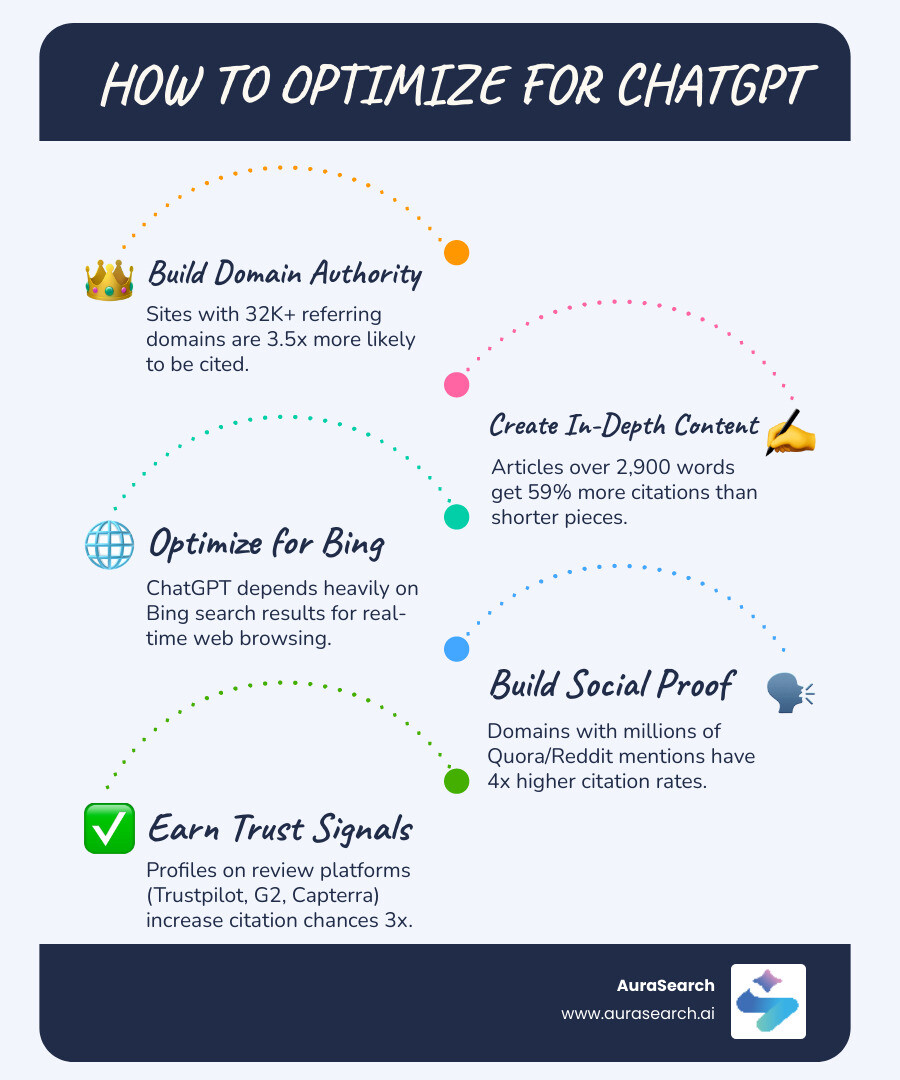
- Build Domain Authority - Sites with 32K+ referring domains are 3.5x more likely to be cited
- Create In-Depth Content - Articles over 2,900 words get 59% more citations than shorter pieces
- Maintain Fresh Content - Content updated in the past 3 months averages 6 citations vs. 3.6 for older content
- Optimize for Bing - ChatGPT depends heavily on Bing search results
- Build Social Proof - Domains with millions of Quora/Reddit mentions have 4x higher citation rates
- Improve Site Speed - Pages with FCP under 0.4s average 6.7 citations vs. 2.1 for slow pages
- Earn Trust Signals - Profiles on review platforms (Trustpilot, G2, Capterra) increase citation chances 3x
For the first time in 20 years, users are turning away from traditional search engines, representing a fundamental shift in how content is found and recommended.
Unlike Google's reliance on backlinks and keywords, ChatGPT uses training data and real-time web browsing to pull from trusted sources. It cross-references reputable sites, prioritizes expert insights, and weighs social sentiment from platforms like Quora and Reddit.
This new landscape is called Generative Engine Optimization (GEO) . It requires a different approach than traditional SEO, prioritizing content quality, cross-referenced authority, and social proof over perfectly optimized meta tags.
The challenge is that many businesses with strong Google rankings are invisible to ChatGPT. The opportunity lies in getting cited by AI to drive traffic, build trust, and increase conversions as AI search continues to grow.
Basic Optimize for ChatGPT glossary:
How ChatGPT Finds and Ranks Content
To optimize for ChatGPT , you must understand how it processes information. It's not a simple keyword match but a sophisticated blend of understanding, validation, and contextual relevance.
ChatGPT's algorithm analyzes information from multiple reliable sources, combining it into a coherent output. Our research shows it prioritizes five broad factors: Authoritative List Mentions, Awards/Accreditations/Affiliations, Online Reviews, Customer Examples & Usage Data, and Social Sentiment. It values expert insights and consensus across sources, with a unique emphasis on trustworthiness.
ChatGPT sources content from two main avenues: its initial Training Data and its Web-Browsing Capabilities . For current models like ChatGPT-4o, the AI actively browses the web in real-time, making your current web presence incredibly important.
A key factor is its dependency on Bing search. While its recommendations often mirror Google's top results, ChatGPT frequently relies on Bing's ranking factors. Therefore, optimizing for Bing SEO can directly influence your visibility within ChatGPT.
ChatGPT also highly values cross-referencing information . Consistent data across multiple reputable sites signals trustworthiness to the AI. This consensus building is key.
Other critical elements it considers include authoritative list mentions, industry awards, online reviews, and social sentiment, which act as third-party validation and real-world indicators of brand perception.
Understanding the Key Ranking Factors
When we talk about how to optimize for ChatGPT , we're really talking about building a digital footprint that screams "trustworthy" and "authoritative" to an AI. Let's explore the specifics:
- Domain Authority (DA) and Page Authority (PA) : Sites with over 32,000 referring domains are 3.5 times more likely to be cited. High-trust domains (Domain Trust score > 90) earn nearly four times more citations than low-trust sites (score < 43), making a reputable domain a massive advantage.
- Referring Domains : The number and quality of backlinks are crucial. ChatGPT values a variety of backlinks as a sign that different sources find your content reliable.
- Website Traffic : Sites with high organic traffic are favored. Those with over 190,000 monthly visitors get nearly twice as many citations as low-traffic domains. High traffic indicates relevance and authority to AI models.
- Google Ranking Correlation : Pages ranking well on Google (positions 1-45) get about 60% more citations than lower-ranked pages (64–75). This highlights the importance of strong traditional SEO.
- Content Depth : Comprehensive content matters. Articles over 2,900 words average 5.1 citations, while those under 800 words get only 3.2. In-depth content signals expertise.
- Content Freshness : Fresh content performs better. Content updated in the past three months averages 6 citations, versus 3.6 for outdated pages, signaling ongoing relevance.
- Social Proof : Mentions on platforms like Quora, Reddit, and review sites act as trust multipliers. Domains with millions of brand mentions on Quora and Reddit have roughly four times higher chances of being cited.
- User Reviews : Positive user reviews are non-negotiable. They directly impact ChatGPT's willingness to refer your business, acting as real-world validation.
| Ranking Signal | Traditional SEO (Google) | Generative Engine Optimization (ChatGPT) |
|---|---|---|
| Backlinks/Authority | Core ranking factor; quantity & quality. | Crucial; high referring domains & Domain Trust heavily influence citations. |
| Keywords | Exact match, variations, search volume. | Semantic relevance, natural language, user intent, broad topic descriptions over narrow keyword stuffing. |
| Content Quality | E-E-A-T, comprehensiveness, readability. | Paramount; in-depth, factual, well-structured, fresh, snippet-ready, answers direct questions. |
| Technical SEO | Site speed, mobile, schema, crawlability, indexability. | Critical; site speed (FCP), Core Web Vitals, Bing optimization, structured data for AI understanding. |
| Social Signals | Indirect influence, brand mentions. | Direct influence; Quora/Reddit mentions, review platform presence, social sentiment act as strong trust multipliers. |
| User Experience | Dwell time, bounce rate, CTR. | Reflected in site speed, content readability, and ability to quickly answer user queries. |
| Cross-Referencing | Less direct, but implied by diverse backlinks. | Highly valued; consistent information across multiple reputable sources builds AI trust. |
| Awards/Accreditations | Indirect trust signal. | Direct signal; companies with awards are more likely to be recommended. |
| Review Scores | Important for local SEO, brand reputation. | Critical; companies with <70% scores are significantly less likely to be referred. |
| LLMs.txt / FAQ Schema | FAQ schema can generate rich snippets. | Negligible impact for LLMs.txt; FAQ schema shows surprisingly weak results for direct citations (4.2 citations without vs. 3.6 with). Not a silver bullet. |
The Critical Role of Trust and Authority
In AI search, trust is a fundamental requirement. ChatGPT aims to provide reliable answers and looks for strong signals of trust and authority.
Our research shows high-trust domains (Domain Trust score > 90) earn almost four times more citations. This reflects your domain's overall credibility.
Brand mentions are powerful trust signals. Domains with millions of mentions on Quora and Reddit have roughly four times higher chances of being cited. For example, a heavy Quora presence (6.6M mentions) results in 7.0 citations, compared to 1.7 for minimal presence. These platforms signify real-world engagement and community endorsement.
Review platforms like Trustpilot, G2, and Capterra are also vital. Having a profile on these sites can triple your chances of being cited, as they signal customer satisfaction.
Finally, ChatGPT heavily relies on expert insights from industry rankings . Being featured in "best of" lists, winning awards, or being recognized by authorities significantly boosts your citation chances. It's the AI's way of deferring to expert and customer consensus.
For a deeper dive into this new frontier, explore our guide on AI's New Frontier: How to Optimize for Generative Search.
The Ultimate Playbook to Optimize for ChatGPT
Now, let's put that knowledge into action. Optimizing for AI search, or Generative Engine Optimization (GEO), requires a holistic approach blending traditional SEO with AI-specific strategies. This playbook focuses on three core pillars: Content Optimization, Building Digital Presence and Authority, and Technical SEO.
The goal is to build a trustworthy digital identity that AI models can confidently recommend, establishing your brand as a go-to source in the AI-driven landscape. For a comprehensive overview, check out our AI in SEO: Your Essential Guide.
Content Optimization: The Foundation to Optimize for ChatGPT
Content is king, but for AI, it needs to be a benevolent, well-organized monarch. To optimize for ChatGPT , your content must be genuinely helpful, authoritative, and easy for AI to synthesize.
- Content Quality : This is paramount. ChatGPT seeks clarity, factuality, human effort, information gain, and readability. Focus on providing the best possible answer.
- User Intent : Clearly address a specific user intent (e.g., informational, transactional). Align content directly with user goals.
- In-Depth Content : Comprehensive articles are favored. Our data shows articles over 2,900 words average 5.1 citations, and content with 19+ data points averages 5.4 citations. Aim for thoroughness.
- Content Length : While quality is key, longer, detailed content tends to perform better for AI citations by providing a more complete dataset.
- Readability and Section Structure : Use clear headings, subheadings, and concise paragraphs. Pages with an average section length of 120–180 words perform best, averaging 4.6 citations.
- Snippet-Ready Summaries : Start articles with clear, concise summaries that AI models can easily extract to answer direct questions.
- Statistics and Data : Back claims with data. Content rich in statistics (19+ data points) averages significantly more citations, adding credibility.
- Broad Titles and URLs : Broad titles and URLs describing the main topic receive over two times more citations than highly keyword-optimized ones. Prioritize clarity over keyword stuffing.
- Natural Language : Write conversationally, using semantic keyword variations. Answer related questions to help ChatGPT understand the topic's full scope.
For a deeper dive into optimizing your content for this new landscape, explore What is Content Optimization and How AI Transforms It.
Building Your Digital Presence and Authority
Content alone isn't enough; your overall digital presence and authority act as critical trust signals for ChatGPT. This pillar focuses on demonstrating your credibility across the web.
- Backlinks from Reputable Sources : Backlinks remain a strong signal of trust. Focus on earning high-quality, diverse backlinks from authoritative websites in your niche.
- Brand Mentions and Social Listening : Brand mentions are powerful. Monitor social sentiment and seek positive mentions. Domains with millions of mentions on Quora and Reddit have four times higher citation chances.
- Community Engagement : Actively participate on platforms like Quora and Reddit to boost visibility and trust signals for AI.
- Customer Testimonials and Reviews : Encourage customer reviews on your site and third-party platforms. Companies with review scores below 70% are rarely referred by ChatGPT.
- Awards and Accreditations : Publicize industry awards and certifications. They act as powerful third-party validations of your expertise.
- Directory Listings : Ensure your business is listed in reputable online directories to build a consistent, verifiable digital footprint.
For more on this, check out Beyond Keywords: Optimising Content for the AI Search Era.
Technical SEO Checklist to Optimize for ChatGPT
While content and authority are about what you say and who vouches for you, technical SEO is about making sure AI can easily access and understand your message. To effectively optimize for ChatGPT , a solid technical foundation is non-negotiable.
- Site Speed and Core Web Vitals : Speed is a direct AI ranking factor. Pages with a First Contentful Paint (FCP) under 0.4s average 6.7 citations, while pages with an FCP over 1.13s average just 2.1. Optimize all Core Web Vitals for a fast user experience.
- Bing Optimization : Since ChatGPT relies on Bing, optimizing for it is crucial. Submit your site to Bing Webmaster Tools and follow its guidelines for crawling, keywords, and authority.
- Schema Markup and Structured Data : While FAQ schema has shown weak results for direct citations, other structured data is valuable. It helps AI models understand context and relationships on your page, making data extraction easier.
- Keyword Research : Broaden your keyword research to include natural language queries. Focus on semantic variations and related terms rather than exact matches.
- Mobile-Friendliness : A fast, responsive, mobile-friendly website is essential. It provides a positive user experience, which indirectly signals quality to AI.
Advanced Tactics and The Business Impact
Beyond the core pillars, there are advanced tactics that can further improve your visibility and ensure you're using the full power of AI search. The benefits of this optimization extend far beyond simple citations, impacting your traffic, conversions, and brand perception.
Winning Local Searches on ChatGPT
For local businesses, AI search visibility is a game-changer. You want to be the answer when users ask ChatGPT for local recommendations.
- Bing Places Listing : A complete and verified Bing Places listing is essential for local visibility in ChatGPT, similar to Google Business Profile for Google Maps.
- Consistent Local Business Listings : Maintain consistent Name, Address, and Phone Number (NAP) across all online directories (Yelp, Apple Maps, etc.) to build trust with AI models.
- Customer Reviews : Generate fresh, positive reviews on platforms like Google and Yelp. Businesses with review scores below 70% are rarely referred by ChatGPT.
- Local SEO Factors : Traditional local SEO still applies. Optimize for local keywords, build local backlinks, and clearly indicate your service area on your website.
The landscape for local businesses in AI search is evolving rapidly. To stay ahead, consider our insights on Chatbots and SEO: A New Frontier.
Leveraging Prompt Engineering for Content and Insights
Prompt engineering is the art of crafting effective instructions to guide AI models like ChatGPT. It's how we speak the AI's language to get the best possible output.
- Crafting Effective Prompts
:
- Be Clear and Specific : Specify the desired format, length, style, and goals. Provide context like brand voice and target audience.
- Use Action Verbs : Start prompts with words like "Create," "Summarize," or "List."
- Refine Iteratively : Start with a simple prompt, review the output, and refine by adding more detail or asking for examples.
- Define Tone and Style : Explicitly state the desired tone (e.g., friendly, authoritative) to align with your brand voice.
- Structure Complex Prompts : For complex tasks, divide your prompt into sections to ensure a logical flow.
- Content Creation : Use prompt engineering to generate SEO-friendly content outlines, draft articles, or create social media updates.
- Competitor Analysis : Leverage ChatGPT to analyze competitor content or identify popular questions related to keywords.
- Understanding AI Responses : Always critically review and fact-check AI-generated content, revising it to ensure it maintains your unique voice.
For more inspiration on mastering this skill, refer to Prompt engineering best practices for ChatGPT and explore how From Keywords to Content: How ChatGPT Can Supercharge Your SEO Efforts.
Benefits, Limitations, and Ethical Considerations
Optimizing for ChatGPT offers significant rewards, but it's crucial to understand its capabilities, limitations, and the ethical responsibilities involved.
Benefits of Optimizing for ChatGPT Visibility:
- Increased Traffic : Citations from ChatGPT provide direct exposure to its massive user base, driving organic branded traffic.
- Improved Brand Trust : A recommendation from ChatGPT acts as a powerful endorsement, signaling credibility and improving your brand's reputation.
- Higher Conversions : Increased traffic and trust lead to higher conversion rates.
- Early Mover Advantage : Optimizing now establishes a strong foothold and competitive edge as AI search grows.
AI Limitations and Ethical Considerations:
- Hallucinations : AI can generate inaccurate or fabricated information. Always fact-check AI-generated content before publishing.
- Bias : AI models can reflect biases from their training data. Be mindful of potentially unfair responses.
- Over-Agreeableness : Models may say what sounds nice rather than what is accurate, requiring human oversight.
- Vulnerability : AI can feel personal. OpenAI is working to improve responses for vulnerable users by pointing them to evidence-based resources.
- Ethical Dilemmas : The use of AI raises questions about originality, copyright, and misinformation. Use these tools ethically and transparently.
- AI-Driven Content Implications : When using AI for content creation, prioritize quality and trustworthiness over sheer volume.
For guidance on navigating this new landscape responsibly, read our Navigating AI Overviews: Your SEO Survival Guide.
Conclusion
The digital landscape is changing, with AI search platforms like ChatGPT leading the way. To optimize for ChatGPT is to accept Generative Engine Optimization (GEO)—a new discipline prioritizing trust, authority, and high-quality content that AI can easily recommend.
As we've covered, critical factors include domain authority, backlinks, website traffic, and a strong presence on review and social platforms. Content must be comprehensive and fresh, supported by technical fundamentals like site speed and Bing optimization.
Proactive optimization is essential. Ignoring AI search means missing a chance to connect with a growing audience, build trust, and drive conversions. Businesses that implement GEO strategies will be the ones that thrive as the future of search unfolds.
At AuraSearch, we specialize in helping businesses steer this evolving AI-driven search landscape. We provide expert generative AI SEO services to ensure your content gets cited and helps you win in this new era. Don't get left behind—the time to act is now.